How to Care for Thick Coarse Hair: Guide by Hair Type
Learning how to care for thick coarse hair starts with one honest fact: the right routine depends on your curl pattern, your age, your styling habits, and your daily life. Thick, coarse strands often feel dry and wiry, and they tend to need steady moisture, gentle handling, and patience. Results vary from person to person, so treat the ideas below as general information rather than a fixed plan.
Before going further, it helps to separate two terms that people often mix up. "Thick" usually describes how many strands grow from the scalp, while "coarse" describes the width of each individual strand. You can have one without the other, and many people have both. Coarse strands often have a sturdy structure, yet they can still be dry, frizzy, and prone to breakage when they are handled roughly or heated often.
Finding Your Starting Point: Three Common Situations
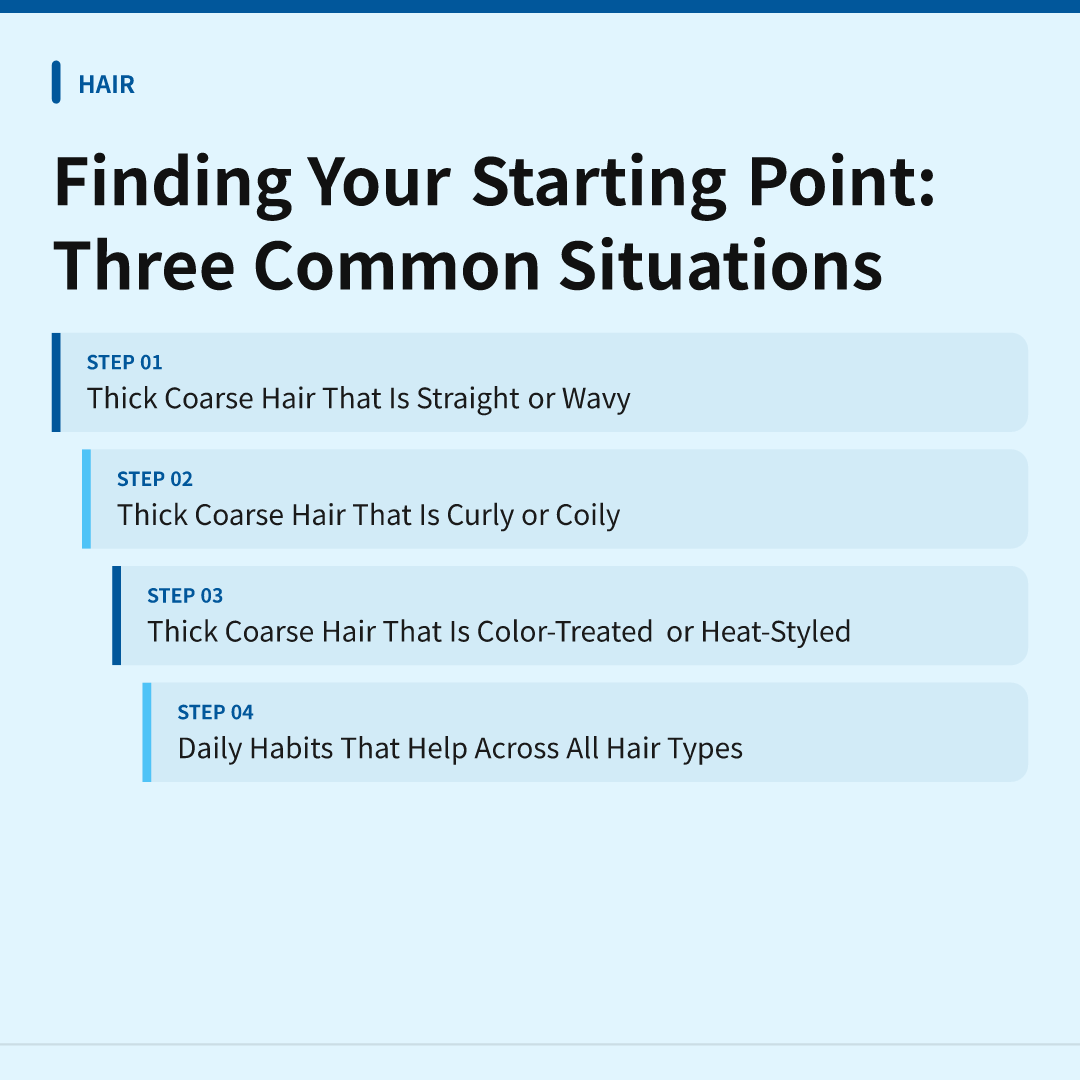
Instead of a single routine for everyone, it is more useful to match your approach to your situation. This guide splits the advice into three groups: naturally straight or wavy thick hair, tightly curled or coily thick hair, and thick coarse hair that is chemically treated or heat-styled often. Many readers fall into more than one group, so feel free to borrow from each section.
A few general ideas apply across all three. Coarse hair tends to lose moisture easily, it can tangle when dry, and it often takes longer to dry after washing. Scalp comfort matters as much as the strands themselves, because a dry, itchy, or flaky scalp can make any routine feel harder.
Thick Coarse Hair That Is Straight or Wavy
What is typical for this group
Straight or wavy thick hair often looks heavy and may feel bulky at the ends. Because natural scalp oils travel down smoother strands more easily, the roots can look oily while the lengths and ends feel dry and rough. Frizz usually shows up in humid weather, and the hair can puff outward instead of lying flat.
Approaches that tend to fit
Many people with this texture look for a gentle, moisturizing shampoo and a conditioner focused on the mid-lengths and ends rather than the scalp. A leave-in conditioner or a lightweight hair oil is often used to smooth the outer surface and reduce frizz. Wide-tooth combs and detangling brushes are commonly preferred because fine-tooth tools can snag and pull.
Haircuts also matter. Some stylists use layering or thinning techniques to reduce bulk, which can make thick hair easier to style and dry. It is worth describing your goals clearly at the salon, since the same cut can behave differently on different hair.
What to be careful about
- Heavy products at the roots: Rich creams and butters can weigh down the scalp area and make hair look greasy.
- Brushing hard when wet: Wet hair is generally more fragile, so aggressive brushing can lead to snapping.
- Very hot styling tools: Frequent high heat can leave coarse hair looking dull and feeling brittle over time.
Thick Coarse Hair That Is Curly or Coily
What is typical for this group
Curly and coily textures are often naturally drier, because the bends in each strand make it harder for scalp oils to travel from root to tip. Thick, coarse curls can also shrink noticeably as they dry, and they may tangle into knots at the ends if left alone for long periods. Many people with this texture describe their hair as strong-looking but easily dehydrated.
Approaches that tend to fit
Moisture is usually the central theme. Many people with curly or coily hair use richer conditioners, leave-in products, and sealing creams or oils to help hold hydration in. Detangling is often done in sections while the hair is damp and coated with conditioner, using fingers or a wide-tooth comb, working gently from the ends upward.
Protective styles such as loose braids, twists, or buns are commonly used to reduce daily manipulation. Satin or silk pillowcases and bonnets are also popular because cotton can absorb moisture and create friction overnight. If a style feels tight or pulls at the scalp, it is generally a sign to loosen it, since ongoing tension may contribute to hair loss around the hairline.
What to be careful about
- Washing too harshly: Strong cleansing formulas can strip already dry strands, so many people choose milder or moisturizing cleansers.
- Tight styles worn for long stretches: Constant pulling on the scalp is something to avoid.
- Dry detangling: Combing through dry, tangled coils often causes breakage.
- Product buildup: Layering many heavy products without periodic cleansing can leave hair feeling stiff and weighed down.
Thick Coarse Hair That Is Color-Treated or Heat-Styled
What is typical for this group
Bleaching, coloring, relaxing, smoothing treatments, and frequent hot tools can change how coarse hair behaves. Processed hair often becomes more porous, which means it may absorb water quickly but lose it just as fast. The result can be rough texture, dullness, tangling, and split ends, even in hair that was originally strong.
Approaches that tend to fit
Gentle, hydrating shampoos and conditioners made for dry or damaged hair are commonly chosen here. Deep conditioning masks and bond-support products are widely used in salons and at home, although how well they work varies between people and products. Air drying when possible and using a heat protectant before tools are common habits, and some people simply lower the temperature setting on their dryer or iron.
Trims on a regular schedule help remove split ends before they travel up the strand. If you plan to color or chemically straighten thick coarse hair, a consultation with a licensed stylist is a sensible step, since they can look at your hair's current condition and talk through realistic expectations.
What to be careful about
- Stacking chemical services close together: Back-to-back processing can leave hair overly weak.
- Skipping patch tests: Hair dyes and relaxers can cause skin reactions in some people, and product instructions usually describe how to check for sensitivity.
- Using heat on very dry hair: Hot tools on already stressed strands can make breakage more likely.
Daily Habits That Help Across All Hair Types
Some habits apply no matter which group you fall into. Gentle towel blotting, instead of rough rubbing, reduces friction on the cuticle. A microfiber towel or soft cotton T-shirt is a popular alternative to standard towels. Detangling from the ends upward, rather than dragging a brush from the roots, is generally easier on thick strands.
Washing frequency is personal. Some people with dry, coarse hair wash less often to avoid stripping, while others with an oily scalp prefer more frequent cleansing. A common middle ground is to cleanse the scalp thoroughly and let the rinse-off suds glide over the lengths. Wearing hair loosely, avoiding tight elastics, and choosing snag-free accessories can also reduce unnecessary stress on the strands.
Nutrition, sleep, and overall health can influence how hair looks and feels, though no single food or supplement is known to transform hair texture. If you are considering supplements, it is sensible to talk with a pharmacist or doctor first, because they can consider your health history and any medicines you take.
Reading Product Labels Without Getting Overwhelmed
Product aisles can feel confusing, but a few general ideas help. Ingredients often marketed for dry hair include humectants that attract water, emollients that soften, and oils or butters that help seal moisture. Heavier formulas tend to suit coarse, dry, or curly hair, while lighter ones often suit straighter, thick hair that gets weighed down easily.
Fragrance, essential oils, and certain preservatives can bother sensitive scalps. According to the U.S. Food and Drug Administration's general consumer guidance on cosmetics, products can cause reactions in some people, and it is reasonable to stop using a product if irritation develops. Reactions vary from person to person, so a new product is often introduced one at a time, which makes it easier to notice what might be causing a problem.
Common Cautions and When to Get Professional Help
Whatever your hair type, a few warning signs deserve attention instead of more home experimenting. Hair that is thick and coarse can still be affected by scalp or health conditions, and a routine change will not solve every problem. The American Academy of Dermatology's general public guidance notes that persistent hair or scalp changes are worth discussing with a board-certified dermatologist.
Consider reaching out to a licensed health professional if you notice any of the following:
- Noticeable shedding or thinning patches, or a widening part that seems new.
- A scalp that stays red, painful, scaly, or intensely itchy despite gentle care.
- Sores, crusting, swelling, or drainage on the scalp.
- Hair loss along the hairline or temples, especially after wearing tight styles.
- A sudden change in hair texture or strength that coincides with other health changes.
- Burning, blistering, or swelling after a dye, relaxer, or other chemical service.
In short, how to care for thick coarse hair comes down to matching your routine to your texture and habits, handling strands gently, and paying attention to your scalp. Straight, curly, and chemically treated hair each call for slightly different choices, and what works for a friend may not work for you. If something feels off, or the signs above appear, a doctor, dermatologist, or licensed stylist is the right next step for personal guidance.
Disclaimer: This article is for informational purposes only and is not a substitute for professional medical advice, diagnosis, or treatment. Please consult a licensed professional for personal health decisions.
Related reading: How to Find Your Hair Type, Step by Step