How to Find Your Hair Type, Step by Step
Figuring out your hair type can feel strangely confusing when product labels, social media charts and salon vocabulary all use different words for the same thing. One brand says "wavy," another says "2B," and your own hair seems to do three different things on three different days. The fix is to work in order: observe first, then name what you see, then adjust your routine slowly. This guide follows that sequence so you can identify your hair type without guesswork.
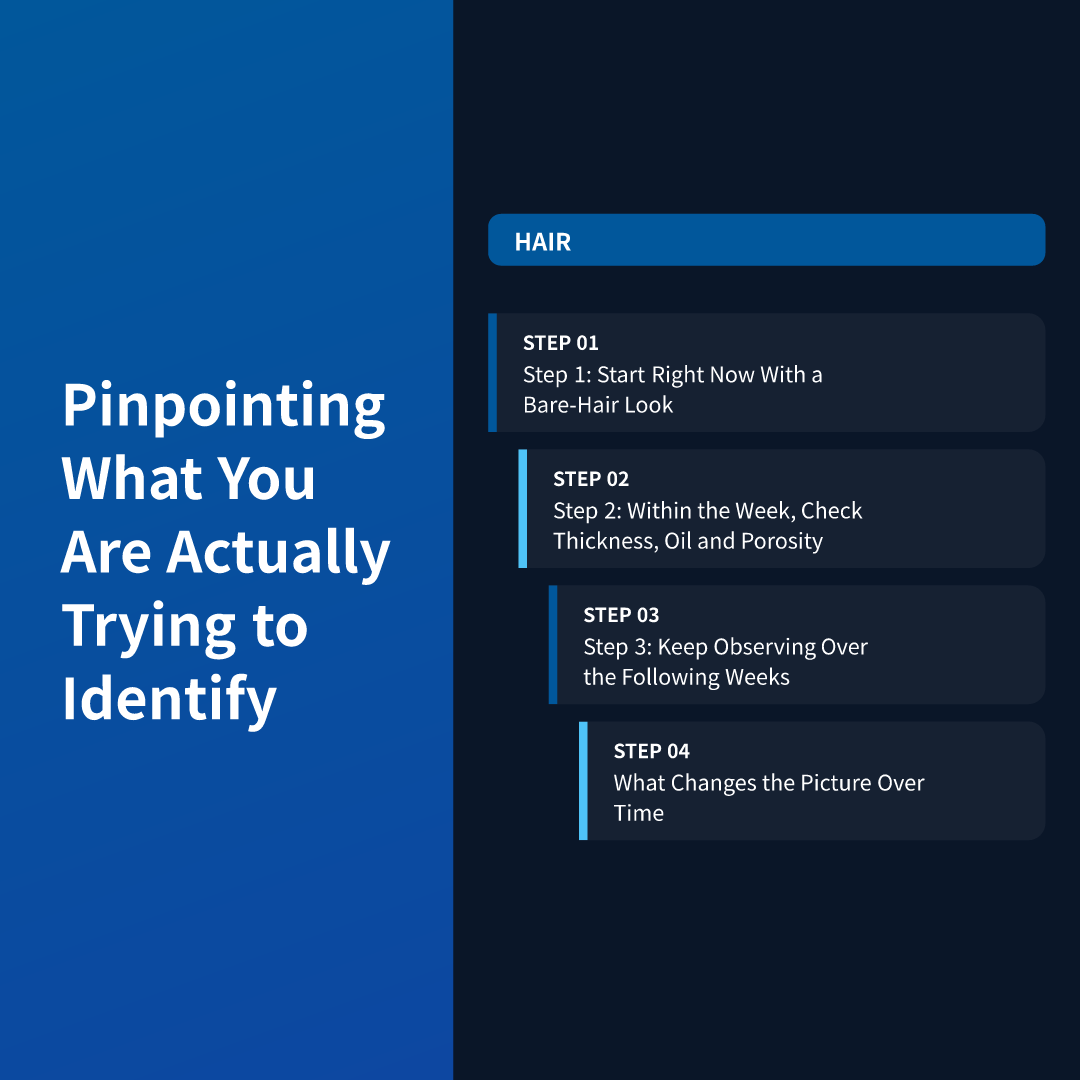
Pinpointing What You Are Actually Trying to Identify
"Hair type" is a loose phrase that usually covers several separate traits. Mixing them together is the main reason people feel stuck. Before you look in the mirror, it helps to know which traits matter.
The traits that make up hair type
- Curl pattern: whether hair grows straight, wavy, curly or coiled.
- Strand thickness: the width of each individual hair, often described as fine, medium or coarse.
- Density: how many strands grow in a given area, which affects how full the hair looks.
- Oil level: how quickly the scalp produces sebum and makes roots look greasy.
- Porosity: how readily the hair takes in and holds moisture.
Most people have a mix. You might have fine, wavy, low-density hair with an oily scalp, and that combination explains far more than a single label would. Keep that in mind as you go, because the goal is a useful description rather than a perfect category.
Why one label is rarely enough
Popular charts sort hair into numbered and lettered groups, and they can be a handy shared vocabulary. Still, they describe curl shape and little else. Two people with the same curl label can need very different care if one has thick, dry strands and the other has fine, oily ones. Treat any chart as a starting point, not a verdict.
Step 1: Start Right Now With a Bare-Hair Look
The quickest way to begin is to look at your hair in its natural state, without heat tools or heavy styling products. Do this today if you can.
- What to do: Wash your hair with a gentle shampoo, skip heat and strong styling products, and let it air dry. Then look at it in natural light.
- How to read it: Notice whether strands dry straight, bend in an S shape, form loose loops or spring into tight coils. Check the roots, the mid-lengths and the ends separately, because they often differ.
- Why it matters: Heat, brushing and styling products can temporarily change the shape of your hair. Air drying shows you what your hair does on its own.
If your hair looks different at the back than at the front, that is common. Many people have more than one pattern on the same head, and hormonal changes, aging and past damage can all shift texture over time.
A quick note on shrinkage and humidity
Curly and coily hair often looks much shorter when dry than when wet, and the pattern can look looser or tighter depending on the day. Humid weather can make waves frizzier or curls more defined. Take that into account and look at your hair on more than one occasion before settling on a description.
Step 2: Within the Week, Check Thickness, Oil and Porosity
Once you have a sense of the curl pattern, spend the next several days gathering a few more clues. None of these observations need special equipment.
Checking strand thickness
- What to do: Take a single clean, dry strand and roll it between your thumb and forefinger.
- How to read it: If you can barely feel it, the hair is likely fine. If it feels like a noticeable thread, it is probably medium. If it feels wiry or rough, it tends toward coarse.
- Why it matters: Fine hair is often weighed down by heavy products, while coarse hair frequently asks for richer ones. Thickness shapes what feels comfortable on your hair.
Thickness is not the same as density. You can have fine strands that are packed closely together, which looks full, or thick strands that are sparse. Parting your hair and looking at how much scalp shows through gives a rough impression of density.
Watching how your scalp behaves
- What to do: Over several days, note how soon after washing your roots start to look flat or greasy, and whether your scalp ever feels tight or flaky.
- How to read it: Roots that look oily within a day suggest an oilier scalp. Roots that stay comfortable for several days suggest a drier or more balanced one. Many people are oily at the roots and dry at the ends.
- Why it matters: Oil level helps you decide how often washing feels right for you and which formulas suit your scalp, though individual needs vary widely.
Persistent itching, heavy flaking, redness or sore patches go beyond ordinary oil patterns. The American Academy of Dermatology offers general guidance on common scalp conditions, and a dermatologist is the right person to ask if you notice these signs.
Estimating porosity
Porosity describes how easily moisture gets in and out of the hair shaft. Hair that absorbs water quickly and dries fast is often described as high porosity, while hair that seems to repel water and takes a long time to get wet is often described as low porosity. Some people try the "float test," dropping a strand into a glass of water, but results can be thrown off by product buildup and oils, so treat it as a loose hint at best.
A more practical clue is how your hair behaves day to day. Hair that feels dry soon after washing, tangles easily or frizzes in humidity may be taking in and losing moisture quickly. Hair where products seem to sit on top without soaking in may lean the other way. Chemical coloring, bleaching and frequent heat can raise porosity, so it is not always a fixed trait.
Step 3: Keep Observing Over the Following Weeks
Hair changes with seasons, products, stress, age and styling habits. A single afternoon of observation gives you a snapshot, while a few weeks gives you a pattern you can trust.
- What to do: Keep brief notes, on your phone or on paper, about how your hair looks and feels after washing, the next day and by the end of the week. Add the weather and any new products.
- How to read it: Look for repeating themes, such as frizz on humid days, limp roots after heavy conditioners or dry ends that tangle every time.
- Why it matters: Patterns show you which traits are stable and which are reactions to products or conditions.
Related reading: Does Hard Water Affect Your Hair? What to Know
Change one thing at a time
When you try a new shampoo, conditioner or styling product, change only one item at once. If you swap everything together, you cannot tell what helped and what caused trouble. Reactions to hair and scalp products vary from person to person, so if something causes itching, burning or redness, stopping and asking a pharmacist or dermatologist is the sensible move. For medicated shampoos in particular, follow the product label and ask a pharmacist or doctor about how to use them.
Match your vocabulary to your findings
After a few weeks, try summing up your hair in one sentence, such as "fine, wavy, oily at the roots, dry at the ends, medium porosity." That description is more useful than any single label when you are shopping, reading reviews or talking to a stylist. It also makes it easier to spot product advice that does not fit you.
Related reading: How to Care for Color-Treated Hair That Fades or Feels Dry
What Changes the Picture Over Time
Even a careful assessment can shift. Several everyday factors are commonly linked with changes in how hair looks and behaves:
- Heat styling and coloring: repeated exposure can roughen the outer layer of the hair, which may change how it feels and holds moisture.
- Hormonal shifts: pregnancy, postpartum months and menopause are often associated with changes in texture and shedding.
- Age: hair can grow finer or drier, and gray hair often has a different texture from pigmented hair.
- Climate and season: humidity, cold air and indoor heating can all alter how hair behaves.
- Tight styles: constant tension from braids, ponytails or extensions can stress the hairline.
If your hair has recently changed in a way you cannot explain, a clinician can help sort out whether it is a normal shift or something worth looking into.
When Self-Assessment Is Not Getting You Anywhere
Sometimes the observations stay muddy, the routine never feels right, or the hair itself seems to be changing for reasons you cannot pin down. That is a reasonable point to bring in a professional.
A hairstylist can help with texture and care questions
A licensed hairstylist who works with your type of texture can often identify curl pattern, thickness and condition quickly, and can talk about cutting and styling choices that suit them. This is a cosmetic and styling conversation, so it is worth asking how they approach your specific texture before booking anything chemical. Results differ between people, and no stylist can promise how your hair will respond to a given product or service.
A dermatologist is the right call for scalp and shedding concerns
According to the American Academy of Dermatology, hair and scalp changes can have many different causes, and some benefit from a medical evaluation. Consider booking an appointment if you notice any of the following:
- Noticeable thinning, widening of your part or bald patches.
- Shedding that seems heavier than usual and continues for a long stretch.
- A scalp that is persistently itchy, painful, scaly, red or sore.
- Hair breakage that continues even after you have simplified your styling.
- Sudden texture changes alongside other health symptoms.
These signs are not something to diagnose from a mirror, and they are not solved by learning your curl pattern. A licensed medical professional can examine your scalp, ask about your health history and recommend next steps suited to you.
Knowing how to find your hair type is mostly a matter of patient observation: curl pattern, thickness, oil and porosity, checked over time rather than in one sitting. If those observations stay unclear, or your scalp and shedding raise concerns that a routine will not fix, a stylist or dermatologist is the better place to take your questions.
Disclaimer: This article is for informational purposes only and is not a substitute for professional medical advice, diagnosis, or treatment. Please consult a licensed professional for personal health decisions.