How to Care for Color-Treated Hair That Fades or Feels Dry
Dull, tired-looking dyed hair can come from very different causes, and a fix that works for one may do almost nothing for the other. If you're wondering how to care for color-treated hair, the first step is working out whether the shade itself is slipping away or the strands underneath are struggling. The two problems often show up together, but they are not the same thing. Below they are pulled apart so you can match your habits to what is actually happening.
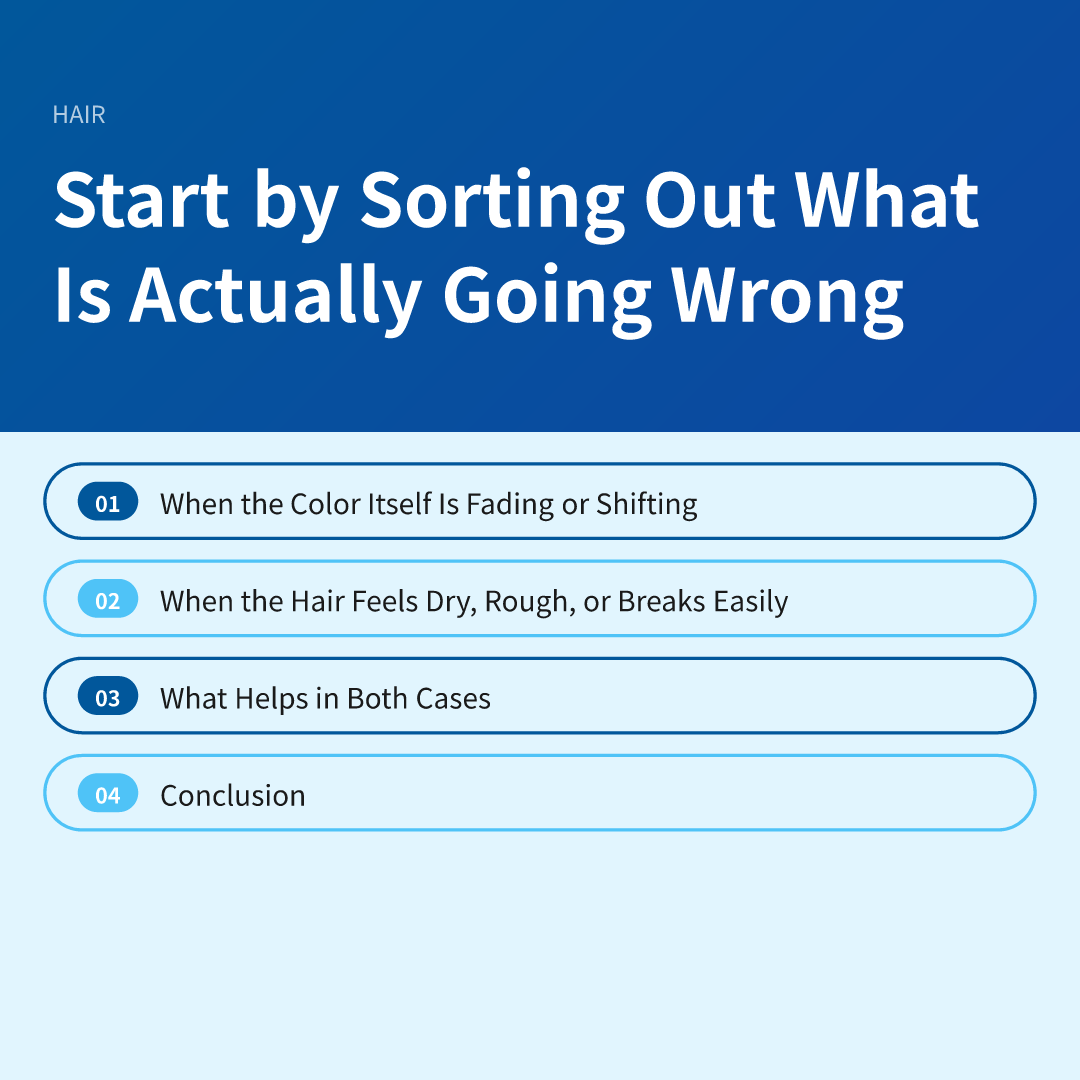
Start by Sorting Out What Is Actually Going Wrong
Hair color is a cosmetic process. Depending on the product, it either deposits pigment on or near the surface or changes the hair's natural pigment inside the strand, and lightening steps can leave the hair more porous. Two things then tend to go wrong: the color leaves faster than you'd like, or the hair's texture changes. Both get called "damaged color," which is why people buy the wrong product.
A quick way to separate them is to ask what bothers you most when you look at and touch your hair.
- Mostly a look problem: the shade seems flatter, lighter, or warmer than it did after the appointment, but the hair still feels reasonably smooth and moves normally.
- Mostly a feel problem: the shade looks close to how it started, but the hair feels rough, tangles easily, snaps when brushed, or dries stiff and puffy.
- Both at once: common with lightened or repeatedly colored hair, where porous strands hold pigment poorly and also feel dry.
A third possibility deserves a separate mention. If the scalp itches, burns, swells, or breaks out in a rash around a coloring session, that isn't a hair-care puzzle. It is something to bring to a qualified professional, and it is worth mentioning before any future coloring.
When the Color Itself Is Fading or Shifting
How to tell this is your situation
Fading usually announces itself through the shade, not the texture. Reds and vivid fashion colors often look softer first. Dark browns may drift warmer. Blondes and lightened hair can pick up a brassy or yellowish cast. Hair that has been through the same routine for weeks and looks noticeably different in daylight than it did at the salon is a good candidate.
One simple check is comparing a photo taken soon after coloring with how your hair looks now in similar lighting. Another is looking at a hidden section near the nape, which sees less sun and friction. If that section holds the shade better than the top layers, exposure and daily handling are the likely culprits.
What tends to help
Pigment leaves the hair through water, friction, heat, and sun, so the helpful habits are mostly about reducing those exposures.
- Water temperature. Hot water is commonly described as opening up the hair's outer layer, so many people find that lukewarm or cool rinsing keeps color looking fresher longer.
- Wash frequency. Every wash pulls a bit of pigment out. How often suits you depends on your scalp's oiliness, your hair texture, and how much your hair gets sweaty or styled, and there is no single right number.
- Cleansing formulas. Products labeled for colored hair are designed to be gentler on dye, though label claims vary between brands. Deep-cleaning or clarifying formulas are generally meant to strip buildup, and many people find they also strip color faster.
- Sun and heat. Prolonged sun exposure is often cited as a reason for tone changes, particularly in lightened hair. Hats and scarves are a low-effort buffer, and heat tools can dull shade as well as dry the hair.
- Tone-adjusting products. Color-depositing conditioners and toning products exist for refreshing shade between appointments. Results depend on your base color and the product, so following the product instructions or asking your colorist which type suits you is the sensible route.
What gets wasted if you misread it
If the real issue is fading and you respond with heavy repair masks, you may end up with softer hair in the same washed-out shade. Layered treatments can also leave hair feeling weighed down without bringing back any richness. On the other hand, adding a tinted product to hair that is actually rough and porous can lead to patchy, uneven results, because damaged sections take up pigment differently. Matching the fix to the cause saves money and, often, a disappointing week.
When the Hair Feels Dry, Rough, or Breaks Easily
How to tell this is your situation
Dryness and damage show up in how the hair behaves. Strands may feel gummy when wet and straw-like when dry. They may tangle at the ends, look frizzy even in mild weather, or snap into short pieces when brushed. Hair that has been lightened, colored several times in a short period, or colored over previously treated lengths tends to be more prone to this, though individual hair varies a lot.
Some people use a gentle stretch test on a single strand that has already shed naturally. Hair that stretches a lot and does not spring back is often described as overly weakened. That kind of at-home check is only a rough hint, though, and a stylist can judge the condition of your hair far more reliably by looking at and feeling it in person.
What tends to help
Cosmetic products can't rebuild hair that has been broken down, but they can make it feel smoother, tangle less, and hold moisture better. That is often enough to change how the hair looks and behaves day to day.
- Conditioning and moisture. Rinse-off conditioners, leave-in products, and masks coat the hair surface. Richer textures usually suit thicker or coarser hair, while fine hair can feel limp under heavy formulas, so it may take some trial and adjustment.
- Bond-focused products. Some products are marketed as supporting the hair's internal structure after coloring. Marketing claims differ, and the difference people notice can be modest, so it is worth reading the label and keeping expectations realistic.
- Gentle detangling. Working through knots from the ends upward, ideally with a wide-tooth comb while conditioner is in the hair, is commonly suggested to cut down on breakage. Rough towel drying has the opposite reputation.
- Trims. Split, frayed ends tend to travel upward. Having them trimmed is often the only real way to remove them, and how often depends on how quickly your hair grows and how fragile the ends are.
- Spacing out chemical services. Repeated lightening, overlapping color on already treated lengths, or combining color with straightening or perming can add up. A colorist can explain what your hair can reasonably tolerate.
What gets wasted if you misread it
Dryness treated as a color problem leads to a cycle of toning, glossing, and recoloring, each of which can add stress to hair that already needs a break. Shade may look better for a few days while the underlying feel keeps worsening. Another common miss is assuming a rough texture is just "product buildup" and reaching for strong cleansing formulas, which can leave already porous hair feeling even drier. If the hair has been breaking noticeably or thinning rather than just feeling dry, it is reasonable to talk to a professional, since shedding and breakage can have causes unrelated to coloring.
What Helps in Both Cases
Some habits are worth adopting no matter which branch you are on, because they reduce stress on pigment and on the hair fiber at the same time.
- Heat awareness. Hot tools are hard on both shade and texture. Lower temperatures, fewer passes, and heat-protection products are commonly recommended, and air-drying some of the time gives the hair a rest.
- Gentle handling. Tight styles, rough towel rubbing, and brushing wet hair aggressively add friction, which affects both color and breakage.
- Protection from the elements. Sun, chlorinated pools, and salt water can be tough on colored hair. Some people rinse or wet their hair with plain water before swimming, on the reasoning that saturated hair absorbs less of what's in the pool, though this varies.
- Reading labels and asking questions. Ingredients and claims differ widely, and hair type matters. Your colorist knows what was actually used on your hair, and their advice will be more specific than anything general.
- Patience with expectations. Color changes with time even with careful habits. Some fading is normal, and the goal is usually slowing it, not stopping it.
Related reading: How to Reduce Heat Damage From Styling Tools
Conclusion
When the shade is the main concern, meaning it looks flatter, warmer, or lighter while the hair still feels fairly normal, the focus is usually on limiting pigment loss through water temperature, wash habits, sun, and heat, with tone-adjusting products as an option. When the hair feels rough, tangles, or breaks while the color still looks close to fresh, the focus shifts to conditioning, gentle handling, trims, and pacing chemical services. When both are happening, which is common with lightened hair, it usually makes sense to address texture first, since hair that holds moisture better also tends to look more even in shade.
If it is hard to tell which situation you are in, a few options can help. Taking comparison photos in the same lighting over a couple of weeks shows whether the shade is really changing. A visit to the colorist who did the work lets someone examine the hair directly and explain what was used. And any scalp burning, swelling, or rash, or noticeable thinning and breakage, is worth raising with a qualified health professional instead of trying more products. Caring for color-treated hair looks a little different for everyone, and results depend on hair type, coloring history, and daily habits.
⚠️ Disclaimer: This article is for general information only and does not replace professional medical advice.
Disclaimer: This article is for informational purposes only and is not a substitute for professional medical advice, diagnosis, or treatment. Please consult a licensed professional for personal health decisions.