Hair Oil Basics: What Oils Do and Who Needs Them
Hair oil has moved from a niche bathroom shelf item to something people talk about constantly, from social feeds to salon chairs. Part of the reason is simple curiosity: many people notice dry ends, frizz, or dullness and want to know whether a bottle of oil is the missing piece. Another part is the sheer number of products, since every brand seems to offer a different blend with a different promise.
Put plainly, hair oil is a product, either a single plant oil or a blend, that is used to coat the hair surface, soften the feel of strands, and help reduce moisture loss. Those are the hair oil basics worth holding onto: oils mostly work on the outside of the hair, they are not a replacement for water-based moisture, and the right choice depends on your hair type, your habits, and your scalp. Results vary from person to person.
Where Hair Oil Shows Up in Everyday Life
Most people meet hair oil in one of a few ways. A friend mentions a favorite bottle, a stylist finishes a blowout with a few drops of something glossy, or a family tradition includes oiling hair before washing. Each of these contexts uses oil for a slightly different purpose, which is why advice often sounds contradictory.
Scenario one: dry, color-treated hair
Imagine someone with shoulder-length hair who lightens it regularly and uses a hot tool most mornings. Their ends feel rough and look dull, and they wonder whether an oil could help. In a general sense, oils are often used on hair like this because they can add slip, reduce the look of frizz, and make strands feel smoother while the hair is styled. They do not repair damaged hair in a lasting way, since hair strands are not living tissue that can heal itself.
Scenario two: fine, straight hair that gets greasy fast
Now picture someone with fine hair who has heard that oil makes hair shiny. They try a heavy oil near the roots and end up with flat, limp hair by lunchtime. This is a common experience. Fine hair tends to be weighed down easily, so a lighter touch and a lighter oil, concentrated away from the scalp, is a typical consideration. It is also a reminder that more product does not mean better results.
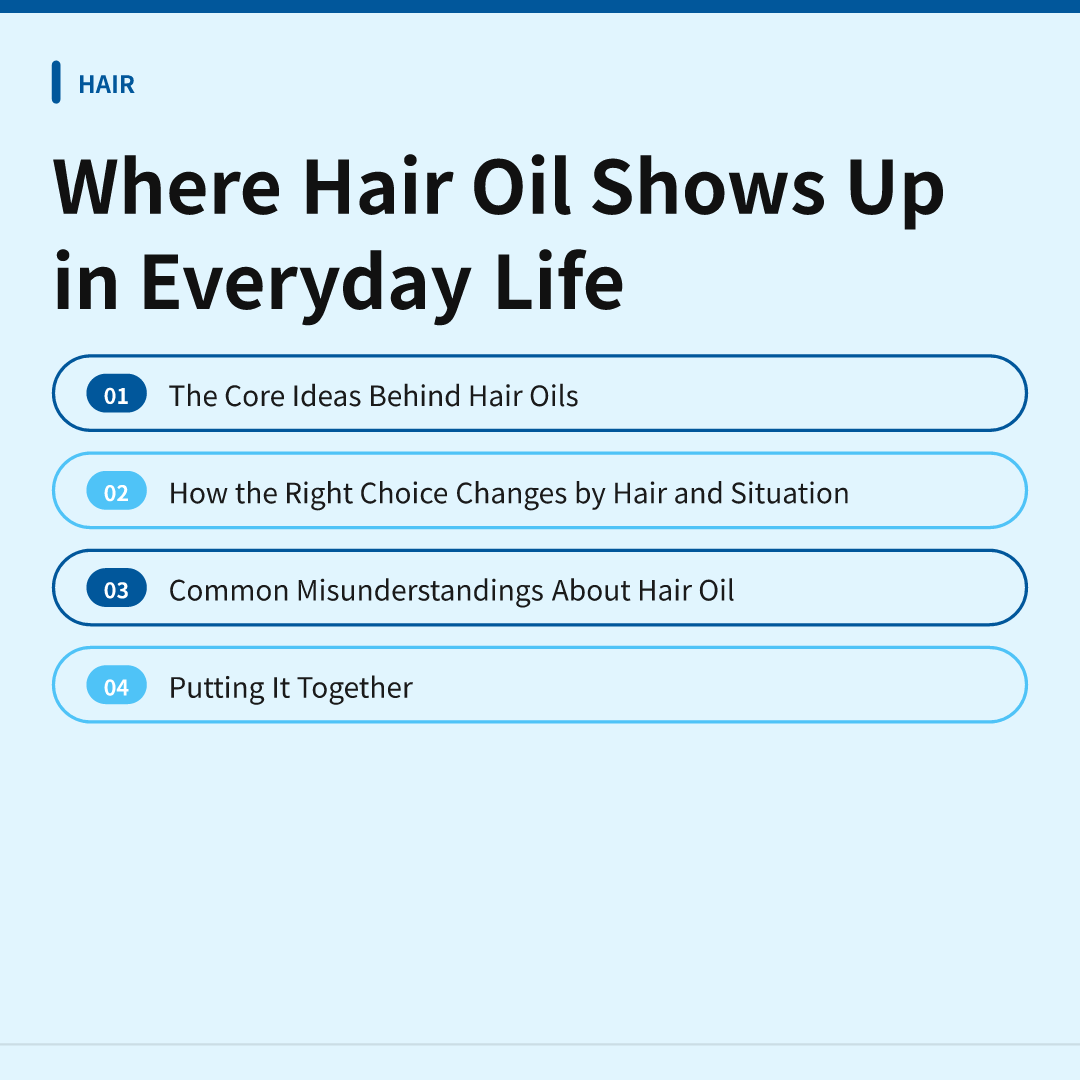
The Core Ideas Behind Hair Oils
A few concepts explain most of what oils do. Once these are clear, product labels become much easier to read.
Oils coat; they do not hydrate on their own
Water is what hydrates hair, and oil is mostly an occlusive layer that sits on top. Many beauty references describe oils as helping to seal in moisture that is already there, which is why they are often applied to hair that is slightly damp or already conditioned. An oil placed on very dry, thirsty hair may make it feel slick without addressing the underlying dryness.
Not all oils behave the same way
Some oils are lighter and spread thinly, while others are thicker and feel richer. Commonly seen ingredients include coconut, argan, jojoba, almond, and sunflower oils, along with silicone-based serums that are sometimes sold alongside them. Each has a different texture and feel on the hair. Because of that, a product that feels lovely to one person may feel greasy or heavy to another.
Common uses people talk about
- Finishing: a small amount on dry hair to smooth the surface and add shine.
- Pre-wash treatments: oil left on the hair before shampooing, a practice with roots in many cultures.
- Heat styling support: products marketed to add slip before using hot tools. Product labels and manufacturers explain how a specific item is meant to be used.
- Scalp massage products: oils designed to be worked into the scalp, which carry different considerations than oils meant for the lengths.
What oils cannot do
Hair oil is a cosmetic product. It is often used to improve how hair looks and feels, but it is not a treatment for hair loss, scalp conditions, or medical concerns. According to the American Academy of Dermatology's general public guidance, hair shedding and scalp changes can have many underlying causes, which is why persistent changes are worth discussing with a clinician rather than trying to solve with a product alone.
Related reading: How to Keep Hair Care Cheap but Effective
How the Right Choice Changes by Hair and Situation
The same oil can feel wonderful on one head and unpleasant on another. Several factors tend to shape that difference.
Hair texture and thickness
Thick, coily, or curly hair tends to be drier by nature because natural scalp oils travel down a curved strand less easily. Many people with these hair types find richer oils and butters feel comfortable. Fine or straight hair often does better with lighter textures and smaller amounts. Medium waves tend to fall somewhere in between, and experimentation is common.
Porosity and damage
Hair that has been bleached, heat styled, or chemically treated often absorbs and loses moisture quickly. People with this kind of hair frequently look for oils as a finishing step to help the surface feel smoother. Hair that is very smooth and resistant to moisture may instead sit under heavy oil and look coated, so product buildup becomes a concern.
Scalp considerations
An oily or easily irritated scalp is a different situation from dry ends. Applying oil near the scalp can feel soothing to some people, while others notice itching, flaking, or breakouts along the hairline. According to the American Academy of Dermatology's general guidance, ongoing scalp itching, scaling, or redness is worth having evaluated, since it may point to a condition that needs attention beyond a cosmetic routine.
Ingredient sensitivities
Plant oils and fragrance blends can trigger reactions in some people, including those with nut allergies or sensitive skin. The U.S. Food and Drug Administration's general consumer information on cosmetics notes that ingredient lists on product labels are there to help people identify what they want to avoid. Reading the label, and asking a pharmacist, allergist, or dermatologist about a known sensitivity, is a sensible step before trying something new. Reactions vary from person to person.
Common Misunderstandings About Hair Oil
Because oils are so widely discussed, a few ideas tend to get repeated even though they do not hold up well.
- "Oil repairs split ends." Oil can make split ends look and feel smoother for a while, but a split strand generally stays split until it is trimmed.
- "More oil means more shine." Too much product often makes hair look stringy or dirty rather than glossy, especially on fine hair.
- "Natural means gentle for everyone." A plant-derived ingredient can still cause irritation or allergic reactions in some people.
- "Oil makes hair grow faster." Hair growth is mainly driven by biology rather than by surface products. Scalp massage and oils are popular, but a cosmetic oil is not a proven growth treatment.
- "Everyone should oil their hair." Plenty of people with healthy, comfortable hair do fine without it.
A note on mixing products
People sometimes layer oils with leave-in conditioners, creams, serums, and styling products. Layering can work, but it can also lead to buildup that makes hair feel coated and weighed down. If hair starts feeling heavy or dull over time, simplifying the routine and washing with a clarifying shampoo as directed on the product label is something many people consider. For specific questions about a product, the manufacturer and a licensed professional are the best sources.
Putting It Together
Hair oil can be a useful finishing touch, particularly for dry or textured hair, but it works at the surface and does not change hair biology. The two scenarios above show why the same bottle can feel perfect for one person and wrong for another: texture, damage, and scalp type all matter. Treating hair oil basics as a starting point rather than a rulebook makes it easier to adjust to your own hair.
Short Conclusion
Here are the main takeaways in three lines:
- Oils mostly coat and smooth the outside of the hair, and they work best alongside water-based moisture rather than instead of it.
- The right type and amount depend on hair thickness, damage level, and scalp comfort, so what suits one person may not suit another.
- Oil is a cosmetic product, not a treatment for hair loss or scalp conditions, and reactions vary from person to person.
It is worth talking with a dermatologist or other licensed professional if you notice persistent itching, scaling, redness, sudden or patchy hair shedding, or a reaction after trying a new product. A pharmacist can also help you check ingredients if you have known allergies. Those are the moments when a professional's view is more useful than another bottle on the shelf.
Disclaimer: This article is for informational purposes only and is not a substitute for professional medical advice, diagnosis, or treatment. Please consult a licensed professional for personal health decisions.