Hair Care Packing for Light Travelers: What to Bring and Why
Carry-on-only trips, budget airline baggage rules, and a general move toward smaller luggage have made hair care one of the trickiest parts of packing. Bathroom shelves are full of products, while a travel pouch has room for only a few. Many people end up searching for guidance after a bag has been overstuffed, or after a trip where their hair felt worse than it needed to.
Deciding what to pack for hair care when traveling light means choosing the smallest set of products and tools that still keeps your hair comfortable, manageable, and clean for the length of your trip. It is a filtering exercise. Each item has to earn its space by doing more than one job or by solving a problem your hair reliably has.
Where This Question Comes Up
The question tends to appear in a few recurring situations. Two imagined, everyday scenarios show how different the answers can be.
Scenario one: a weekend city break. Imagine someone with fine, straight hair flying out on Friday and back on Sunday with one small bag. The hotel offers basic shampoo and conditioner. Their hair rarely tangles, and they do not style it much. For them, a comb, a few hair ties, and perhaps a little dry shampoo may be plenty.
Scenario two: several weeks of backpacking. Now imagine someone with thick, curly hair moving through humid coastal towns and dry mountain areas. They wash in hostel showers or with limited water. Their priorities are moisture, detangling, and a low-effort style, and what they carry looks very different from the first traveler's kit.
Both are packing light, yet their lists barely overlap. That gap is the reason a one-size-fits-all list rarely works.
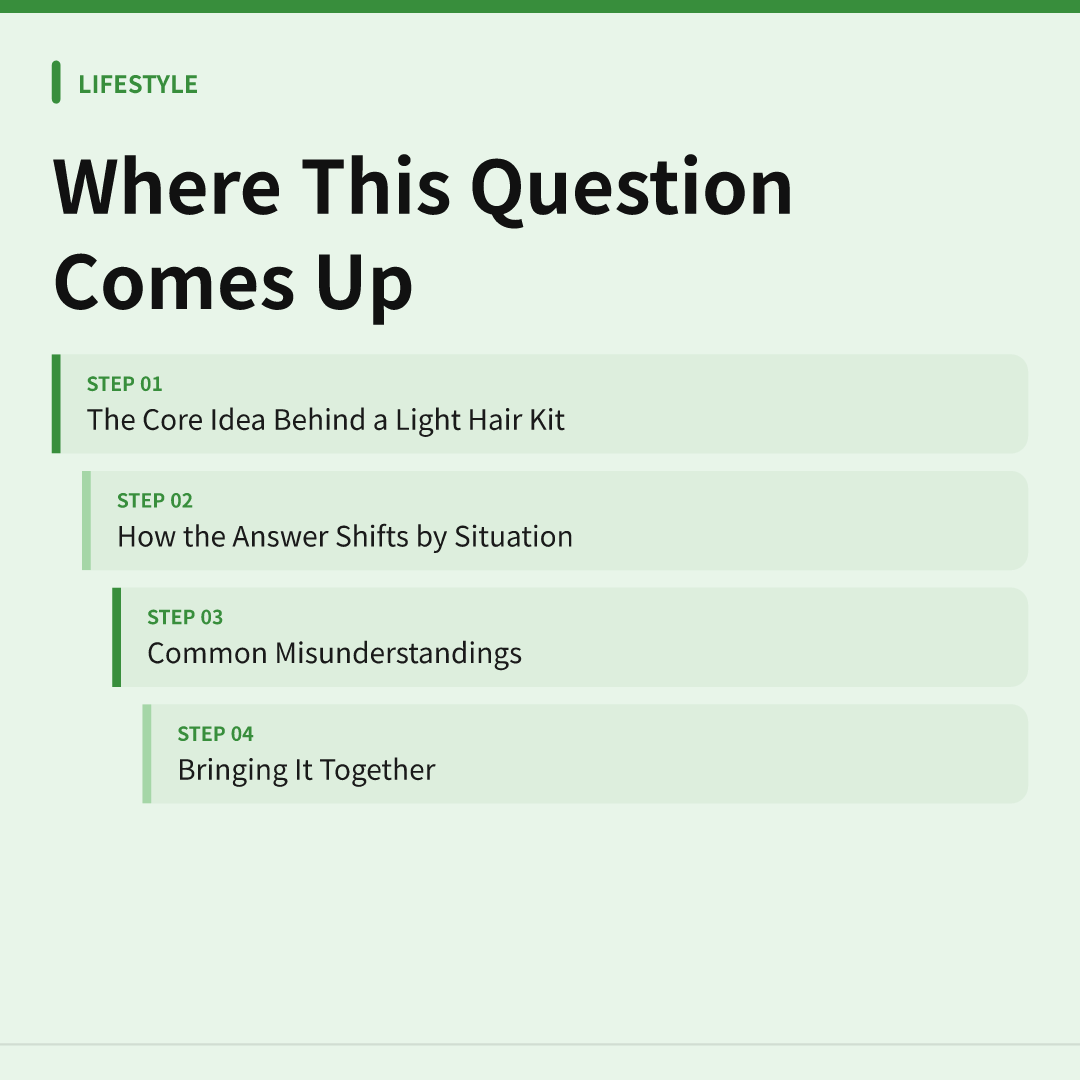
The Core Idea Behind a Light Hair Kit
A light kit is not a shrunken version of your bathroom shelf. It is a short list built around your hair's behavior: how quickly it gets oily, how easily it tangles, whether it frizzes in humidity, and how much styling you genuinely do on a normal day.
Think of it like a capsule wardrobe. A few pieces that mix and match beat a bag full of items that each do one narrow thing. A conditioner that can also smooth frayed ends in small amounts covers two needs with one bottle.
Most kits draw from these building blocks, though no one needs all of them:
- Cleansing: a shampoo, or a bar or sheet-style alternative if you want to sidestep liquid limits.
- Conditioning: a rinse-out conditioner, or a leave-in product if your hair tangles easily.
- Detangling and holding: a compact comb or brush, plus hair ties or clips.
- Protection: a scarf, hat, or silk-style band for sun, wind, or sleeping.
- Optional extras: a small styling product, dry shampoo, or a travel-size heat tool if you rely on it.
How the Answer Shifts by Situation
The tighter your constraints, the more deliberate the list needs to be. The table-style summary below compares the two scenarios above with a flight-focused case.
| Situation | Main constraint | Typical approach |
|---|---|---|
| Weekend city break | Little time, lodging often supplies basics | Bring only what your hair or scalp is picky about; skip the rest |
| Weeks of backpacking | Variable water, climates, and space | Solid bars, multi-purpose balms, and low-maintenance styles |
| Carry-on-only flight | Liquid, gel, and aerosol rules | Small sealed containers, or solid and sheet alternatives |
On flights, rules about liquids differ by country and can change, so check your departure airport's security authority or airline before packing. As one example, the U.S. Transportation Security Administration explains its guidance here: TSA liquids rule.
Climate and activity matter too. Humidity, dry mountain air, salt water, and chlorine all affect hair differently. A light kit can flex with a few additions rather than a second set of products. Salt or chlorine exposure is commonly followed by a thorough rinse, so a compact gentle or clarifying shampoo may be worth the space if you swim often.
Hair type also steers the list. Fine, straight hair may need little beyond shampoo and a comb. Curly or textured hair often benefits from moisture-focused products and protective styling. Color-treated or chemically processed hair may call for gentler cleansing. These are general patterns, and individual hair varies widely.
Styling is another lever. Braids, buns, twists, and clipped-back looks rely on ties and pins instead of heat tools, and using your natural texture often removes the need for bulky appliances. If you do bring a dryer, straightener, or curling iron, check whether it is dual voltage or suits your destination's outlets. The product label or manufacturer's instructions will say, and a mismatch can damage the device or create a safety problem.
Common Misunderstandings
Minimal is not the same as travel-size. Travel-size means the same product in a smaller container. Minimal means fewer products overall. Ten small bottles still take up space and add up at security screening.
Multi-use is not the same as all-in-one. A multi-use product is one you choose because it can reasonably serve several purposes. An all-in-one, such as a two-in-one shampoo and conditioner, bundles functions but may not suit every hair type. Thicker, curlier, or coated hair sometimes needs more slip or moisture than a combined formula provides, while fine, easy hair may be perfectly happy with it.
Packing light is not neglecting your hair. It means being honest about which steps you actually use. If you never use a heat tool at home, leaving it behind is an easy cut. If your hair tangles badly without a leave-in product, leaving it behind is a false economy.
A useful test: if you would not miss an item after two days away from home, it probably does not need a spot in your bag.
Decanting is not risk-free, and buying locally is not always easy. Pouring products into smaller reusable containers cuts bulk, but leaks happen, so sturdy, well-sealed containers matter. Keep liquids in a leak-resistant pouch where you can reach it at security. Buying basics on arrival is another route, though unfamiliar formulas can occasionally irritate a sensitive scalp.
Scalp issues are not a packing problem. Changing water, products, or climate can leave the scalp dry, itchy, or irritated. If yours is sensitive, familiar products are usually more comfortable than experimenting mid-trip.
Bringing It Together
Once light packing is about function rather than product count, two choices get easier. You stop asking whether every product deserves a travel-size version and start asking whether your hair would genuinely miss it. You can also decide ahead of time which items to carry and which easy basics to replace at your destination. Anything your hair or scalp is picky about earns a place in the bag.
Short Conclusion
- Build your kit around how your hair behaves, not around how many products you own.
- Favor items that do more than one job, and adjust for trip length, climate, and airline rules.
- Keep what your hair or scalp is sensitive to; leave behind or replace locally what is easy to find.
If you notice persistent redness, flaking, pain, or hair shedding that worries you, talk with a dermatologist or other qualified clinician before you travel rather than relying on trial and error on the road.
Disclaimer: This article is for informational purposes only and is not a substitute for professional medical advice, diagnosis, or treatment. Please consult a licensed professional for personal health decisions.