How to Care for Wavy Hair Through the Day
The best way to care for wavy hair is to fold small habits into three moments of your day: morning, daytime, and evening. Big overhauls tend to fade after a couple of weeks, while a few gentle, repeatable steps usually stick. Wavy hair sits between straight and curly, so it can look limp one day and frizzy the next, and the goal of a routine is mostly to keep moisture, shape, and friction in balance.
Everyone's waves behave differently. Texture, thickness, porosity, climate, and styling history all change what works, so treat the ideas below as a starting framework rather than a rulebook. As a beauty and lifestyle writer rather than a clinician or stylist, I am sharing general information, and a professional stylist can help you tailor it to your head.
Why Wavy Hair Needs a Slightly Different Approach
Wavy hair often has an S-shaped pattern that is easy to flatten with heavy products and easy to puff up with rough handling. Because the bends in each strand create small gaps in the outer layer, moisture can escape faster than it does in very straight hair. That is one reason waves can feel dry at the ends while the roots turn oily.
Many people also find that waves are sensitive to product weight. Rich creams that suit tight curls can pull waves straight, while very light formulas may not give enough hold on humid days. Finding your own middle ground usually takes some patient trial and error.
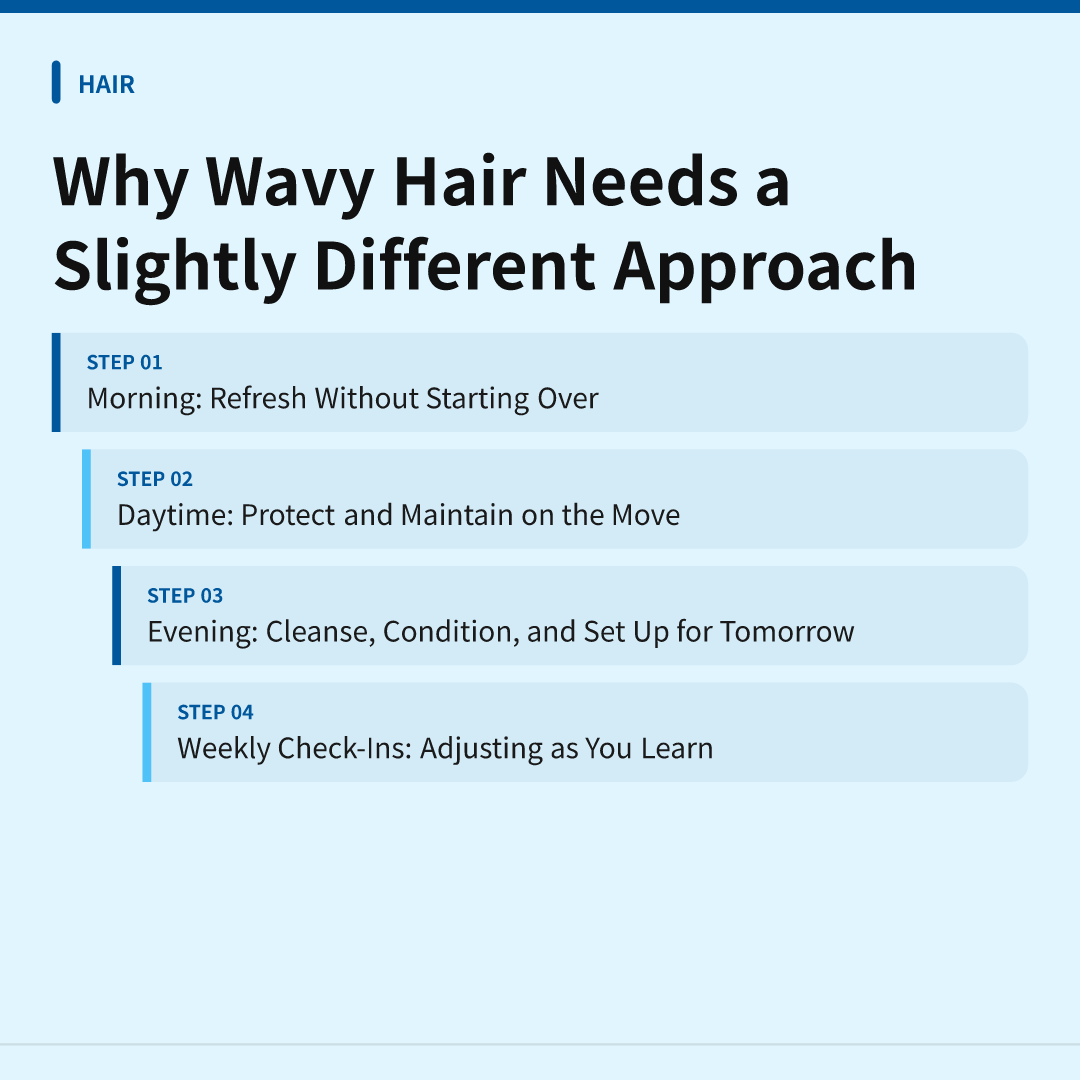
Morning: Refresh Without Starting Over
Mornings are about reviving the shape you already have, not rebuilding it from scratch. Hair that was dried or styled the night before usually only needs a light touch, which also saves time and reduces heat and manipulation.
Rehydrate the waves, don't soak them
A light misting of water, or a water-based refresher made for wavy or curly hair, is a common way to wake up flattened sections. The reason to do it in the morning is that hair has spent hours against a pillow, and bends often loosen or collapse overnight. Slightly damp strands are easier to reshape than fully dry ones, so this is the point in the day when your waves are most cooperative.
If you use a styling product, many stylists describe a general principle: lighter products for fine hair and richer ones for thick or coarse hair. Specific amounts and application methods vary by product, so follow the directions on the label, and check ingredient lists if you have a known sensitivity.
Shape with your hands first
Scrunching or lightly twisting sections with your fingers lets you guide the wave pattern without pulling through it. Brushing dry wavy hair is often associated with frizz because it can break up the natural clumps that give waves definition. If you do like to brush, many people reserve it for the moment hair is wet and coated with conditioner, when strands are more flexible.
If you blow-dry, a diffuser attachment is commonly used because it spreads airflow more gently than a bare nozzle. Heat can dry out hair over time, so lower settings and a heat protectant suited to your hair are frequently suggested. Ask a stylist what fits your hair type before committing to a heat habit.
Daytime: Protect and Maintain on the Move
Between the morning refresh and evening wind-down, your hair meets wind, sun, humidity, hats, and your own hands. A few small habits at this point can keep waves from frizzing or flattening out.
Mind friction and touching
Running fingers through waves again and again tends to disturb the clumps and can add frizz. Scarves, backpack straps, and hood fabrics rub against hair too. If you notice frizz concentrating at the nape or around your shoulders, friction is a likely suspect, and loosening a tie or switching to a softer fabric can help.
For hair ties, many people prefer snag-free or fabric-covered options, and they tend to avoid pulling a tight ponytail in the same spot every day. A loose style, such as a low twist or a soft clip, usually places less stress on strands.
Think about sun, wind, and humidity
Sun and wind can leave hair feeling drier and rougher. A hat or scarf offers a physical barrier, and some leave-in products include UV-filtering ingredients, although how well they work for hair varies and claims differ between brands. On humid days, waves often swell because hair absorbs moisture from the air, and products with humidity-resistant ingredients are a popular choice for some people.
If your scalp gets oily by midday, a gentle approach such as lifting roots slightly or wearing your hair up can be more comfortable than overwashing. Washing frequency is personal, and it depends on your scalp, activity level, and the products you use.
Related reading: How to Protect Hair From the Sun: Fix These Mistakes
Evening: Cleanse, Condition, and Set Up for Tomorrow
Evening is when the heavier work happens, because you are not rushing and you can take care of both your scalp and your lengths. It is also the best time to prepare hair for sleep, since what happens overnight shapes how you look the next morning.
Wash with your scalp in mind
Shampoo is mainly designed to clean the scalp, and the lengths are generally cleansed by the suds running through them. Focusing on the scalp and letting the rinse water handle the ends is a widely shared idea for keeping waves from drying out. How often to wash is a personal call, and there is no single schedule that suits everyone.
Conditioner usually goes through the mid-lengths and ends, where wavy hair tends to be driest. Some people like to detangle with a wide-tooth comb or fingers while conditioner is in, since slip makes snags easier to work through. Rinsing temperature, timing, and product amounts depend on the product, so check the instructions on the packaging.
If you have a scalp condition such as persistent itching, flaking, or irritation, a licensed dermatologist is the right person to ask, because routine tweaks may not address the cause. The American Academy of Dermatology offers general public guidance on common hair and scalp concerns, and it is a reasonable place to start reading.
Dry gently
Rubbing hair with a regular bath towel can roughen the outer layer and encourage frizz. Many people switch to a soft cotton T-shirt or a microfiber towel and gently press or scrunch water out instead. Gentler drying is often linked with better-defined waves, though results vary from person to person.
Prepare for sleep
Cotton pillowcases can create friction, so some people use a silk or satin pillowcase, or a bonnet or scarf made of a smooth fabric. A loose high bun or a soft braid keeps waves from getting crushed and can reduce tangles. The reason this step happens in the evening is simple: overnight is the longest stretch of continuous rubbing your hair experiences.
Weekly Check-Ins: Adjusting as You Learn
Once a week, take a few minutes to notice how your hair is behaving. Hair responds to seasons, hormones, stress, diet, and product changes, so a routine that worked in winter may need small tweaks in summer. Keeping notes can help you separate what truly makes a difference from what is only habit.
Occasional deeper care
Some people add a deeper conditioning mask now and then, especially when ends feel dry or brittle. Others use a clarifying shampoo occasionally to remove product buildup, which can leave waves looking heavy or dull. Both are common practices, but they are not necessary for everyone, and overdoing either may leave hair feeling dry or scalp feeling irritated. Follow the product directions and ask a stylist if you are unsure.
Regular trims are also commonly recommended, because split ends can travel up the strand and make waves look uneven. How often you need one depends on how fast your hair grows, how much heat or coloring you use, and how long you want to keep your length.
When to seek professional help
Sudden or noticeable hair shedding, patchy thinning, a painful or very itchy scalp, or persistent flaking and redness are reasons to see a licensed healthcare professional rather than adjusting your products. Chemical treatments such as bleaching, relaxing, or perming change hair structure, and a stylist can advise on how they interact with natural waves. Patch-testing new products is often suggested for people with sensitive skin or past reactions, and reactions vary from person to person.
Weekly Wavy Hair Checklist
Use this short list as a once-a-week pause. None of it is mandatory, and you can adapt it to your own hair.
- Moisture: Do the ends feel dry or rough, or are the roots getting heavy? Adjust product weight rather than adding more steps.
- Definition: Are waves clumping or turning into frizz? Think about brushing habits, towel drying, and how often you touch your hair during the day.
- Scalp comfort: Note any itching, tightness, flaking, or tenderness, and mention lasting issues to a licensed professional.
- Buildup: Does hair look dull or limp despite washing? Product layering may be the cause.
- Heat and styling: Count how often you used hot tools, and consider lowering the frequency if hair feels stressed.
- Friction: Check pillowcases, hair ties, hats, and scarves for anything that tugs or rubs.
- Ends: Look for splits or uneven lengths that may suggest it is time for a trim.
- Seasonal fit: Ask whether the current weather calls for a lighter or richer routine.
Caring for wavy hair is less about perfection and more about paying steady attention. Learning how your waves respond across the morning, daytime, and evening gives you plenty of information to adjust with, and a trusted stylist or dermatologist can help whenever something feels off.
Disclaimer: This article is for informational purposes only and is not a substitute for professional medical advice, diagnosis, or treatment. Please consult a licensed professional for personal health decisions.