How to Define Curls Without Heat: Match the Fix to the Cause
Two people can both say their curls look undefined, and still need completely different fixes. Learning how to define curls without heat starts with figuring out why your pattern is blurry in the first place: is it frizz from rough handling, weight from buildup, or dryness that keeps strands from clumping? Each cause points to a different habit, and guessing wrong can waste months of product and patience.
This is general beauty information, not personal advice. Hair texture, porosity, scalp condition, and climate all change what works, so treat the ideas below as starting points to test, not rules.
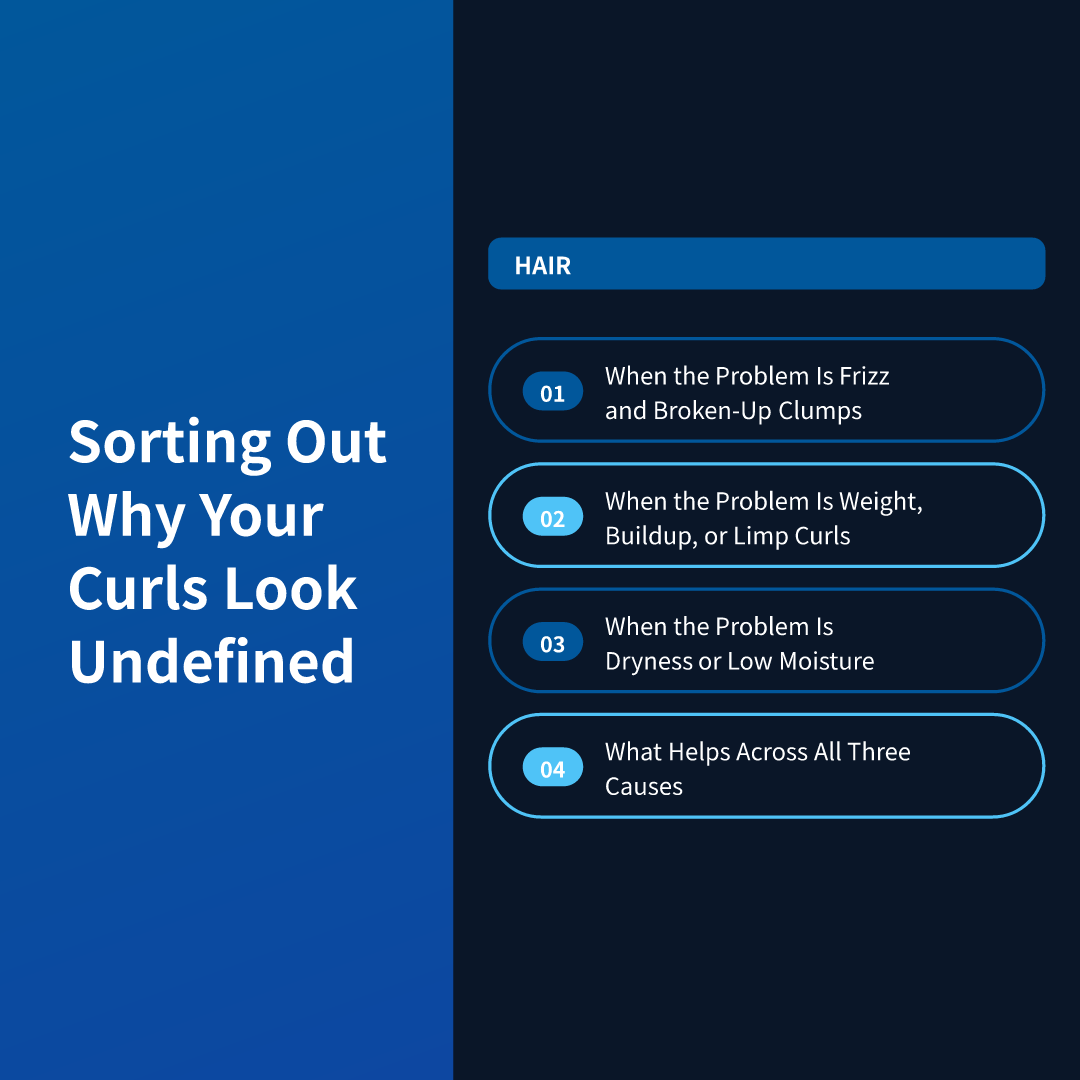
Sorting Out Why Your Curls Look Undefined
"Undefined" is a catch-all word. It can describe curls that look puffy, stringy, flat at the root, or simply loose and inconsistent. Before changing anything, it helps to notice which of these descriptions fits you best.
Three common causes tend to show up when people skip the blow dryer and diffuser and still get disappointing results:
- Frizz and disrupted clumps: curls start out grouped, then break apart into a halo as they dry.
- Weighed-down or limp curls: strands look flat, greasy, or stretched, and the curl springs back poorly.
- Dry, thirsty hair: curls look rough, dull, and fluffy, with little shine and no real pattern.
Some people have a mix, and that is normal. Hair that is dry at the ends can be heavy with product at the roots, for example. Pick the cause that feels most dominant, try the matching approach for a few wash cycles, and adjust from there.
When the Problem Is Frizz and Broken-Up Clumps
How to tell this is your situation
Your wet hair probably looks great. Curls are grouped, springy, and shiny in the shower, but by the time they dry, the shape has fractured into fuzz. Another clue is that the frizz is worst on the outer layers and around the crown, where hands, pillows, and air touch your hair most.
If this sounds familiar, the issue is usually not a lack of product. It is more often about what happens to the curl while it is wet and while it is drying.
What commonly helps
Beauty educators often describe a handful of habits for protecting curl clumps while hair air-dries. None of them is magic, and results vary from person to person.
- Style while hair is very wet. Many people find that curls hold together better when product goes on soaking wet hair rather than damp hair, since water helps strands slide into their natural groups.
- Try scrunching with gentle pressure. Cupping sections upward toward the scalp can encourage the curl to bend into its natural shape.
- Swap the bath towel. A soft cotton t-shirt or microfiber towel creates less friction than regular terry cloth, which can rough up the cuticle.
- Leave it alone while it dries. Touching, fluffing, or running fingers through half-dry curls is a frequent cause of frizz. The hair often looks its best once it is fully dry and any gel cast is softened by hand.
A gel or similar styling product is commonly used to form a flexible "cast" that holds the curl pattern as it dries. Product labels and brand instructions explain how a specific item is meant to be used, so check those rather than relying on a general rule.
If you guessed wrong
If your hair is actually dry rather than frizzy from handling, extra scrunching and hands-off drying will not fix the fuzz. You will keep getting the same rough texture and might blame the technique. On the other hand, if the real issue is rough handling and you keep adding heavier creams, you may end up with weight and buildup on top of frizz.
Related reading: How to Care for Curly Hair Day to Day
When the Problem Is Weight, Buildup, or Limp Curls
How to tell this is your situation
Curls look stretched or stringy, even when they are freshly styled. Roots go flat quickly, and the hair may feel coated, waxy, or oddly stiff in some places and limp in others. If you layer several leave-in products, oils, and creams, this is a likely candidate. Hard water can also leave a film on hair for some people, though that depends on where you live.
A useful clue is whether your curls looked better a few weeks ago, before your routine got more complicated. Hair that has changed for the worse as you added products often points toward buildup.
What commonly helps
- Simplify the routine. Fewer layers, applied more evenly, can let curls bounce without being pulled down.
- Consider a clarifying shampoo occasionally. These are commonly used to remove residue from styling products. Because they can feel drying on some hair types, how often to use one is a personal call, and a stylist familiar with curly hair can help you decide.
- Look at ingredient lists. Heavy butters, waxes, and some silicones can be too much for fine or low-density curls, while thicker hair often tolerates them well.
- Use lighter textures. Mousses, light gels, and foam-style stylers are often chosen by people whose curls collapse under rich creams.
Sensitive scalps deserve extra care here. According to the American Academy of Dermatology's general guidance on hair and scalp care, persistent itching, flaking, redness, or irritation is worth discussing with a dermatologist rather than treating with a stronger and stronger shampoo routine. A scalp issue can mimic or add to buildup symptoms, so it is worth keeping separate.
If you guessed wrong
Clarifying hair that is actually dry can leave it feeling even rougher and more tangled. If limp curls are really a moisture or protein balance issue, stripping the hair may make definition worse for a while. When in doubt, try one change at a time so you can tell what made the difference.
When the Problem Is Dryness or Low Moisture
How to tell this is your situation
Dry curls tend to look dull and feel rough or straw-like. They may tangle easily, absorb product quickly, and look puffy rather than clumped. Ends often feel brittle, and curls may not "bounce back" when gently stretched. Coloring, bleaching, and frequent heat or chemical styling in the past can all contribute, and so can a naturally dry hair type.
What commonly helps
- Add moisture before holding product. A conditioner or leave-in is often applied before gel so the curl has something to hold in.
- Detangle gently. Many people prefer working through knots with conditioner in the shower using fingers or a wide-tooth comb, since dry brushing can pull curls apart.
- Be patient with damage. If heat, bleach, or other processing has altered the hair, curls may not fully return to their earlier pattern. Gradual improvement as healthier hair grows in is more realistic than a quick change.
- Protect at night. A satin or silk pillowcase or bonnet is commonly used to cut down on friction while sleeping.
Be careful not to confuse dryness with a medical hair problem. According to the American Academy of Dermatology, sudden or unusual hair thinning, breakage in patches, or a painful or inflamed scalp are reasons to check in with a dermatologist instead of simply changing products.
If you guessed wrong
Piling on heavy moisture when your real issue is buildup can leave curls greasy and flat. Likewise, adding more conditioner to curls that are mainly frizzing from handling will not change the habit that causes the frizz. Matching the fix to the cause saves money and frustration.
What Helps Across All Three Causes
Some habits are useful no matter which cause fits you best. They are low-risk and worth testing alongside the targeted changes above.
- A good cut. Curls often form more cohesive shapes when the cut works with the pattern. A stylist experienced with curly hair can shape ends so curls stack and clump more easily.
- Consistent technique. Changing five things at once makes it hard to learn anything. Keeping the method steady for several washes gives a fairer picture.
- Patience with drying time. Air-drying takes longer than using a diffuser, and some people find that hair looks different at each stage. Letting it dry fully before judging is usually wise.
- Gentle scalp and hair care. Rough scrubbing, tight styles, and harsh products can add to frizz and breakage over time.
- Realistic expectations. Curl pattern is largely a matter of genetics, so products can support definition but cannot create a pattern your hair does not naturally have.
Product reactions vary. Anyone prone to allergies or scalp sensitivity may want to read ingredient lists carefully and follow label directions. If a product causes burning, swelling, or a rash, stop using it and ask a pharmacist or doctor about next steps. The U.S. Food and Drug Administration's general consumer guidance on cosmetics notes that people can react differently to the same ingredients, which is why paying attention to your own skin matters.
Bringing It Together
If your curls clump beautifully when wet but fall apart as they dry, handling and friction are the likely culprits, and a hands-off drying approach with gentle towel habits is a reasonable first experiment. If curls look limp, coated, or stretched, buildup or overly rich products may be weighing them down, so simplifying and occasionally clarifying may help. If hair looks dull, rough, and puffy with little pattern, dryness is more probable, and consistent moisture plus gentle detangling is the usual direction.
Not sure which one applies to you? Try changing a single variable for a few washes and keep notes. A stylist who works with curly textures can look at your hair in person and spot things photos and descriptions miss, and a dermatologist is the right person for scalp symptoms that do not settle down. Learning how to define curls without heat is mostly a process of observing your own hair, and results build gradually rather than overnight.
Disclaimer: This article is for informational purposes only and is not a substitute for professional medical advice, diagnosis, or treatment. Please consult a licensed professional for personal health decisions.