How to Build a Weekly Hair Care Schedule That Fits You
Two people can both say their hair feels "off," yet the reasons behind it may be completely different, and so is the fix. Learning how to build a weekly hair care schedule starts with figuring out what is actually driving the problem: an oily scalp, dry or damaged lengths, or a mix of both. A schedule copied from someone else often wastes products and time, because it solves a problem you may not have.
This guide walks through the most common causes behind hair that feels greasy, dry, or hard to manage, and how each one can shape a weekly rhythm. It also covers what helps nearly everyone, and when a professional opinion makes more sense than another product.
Sorting Out What Is Really Behind Your Hair Troubles
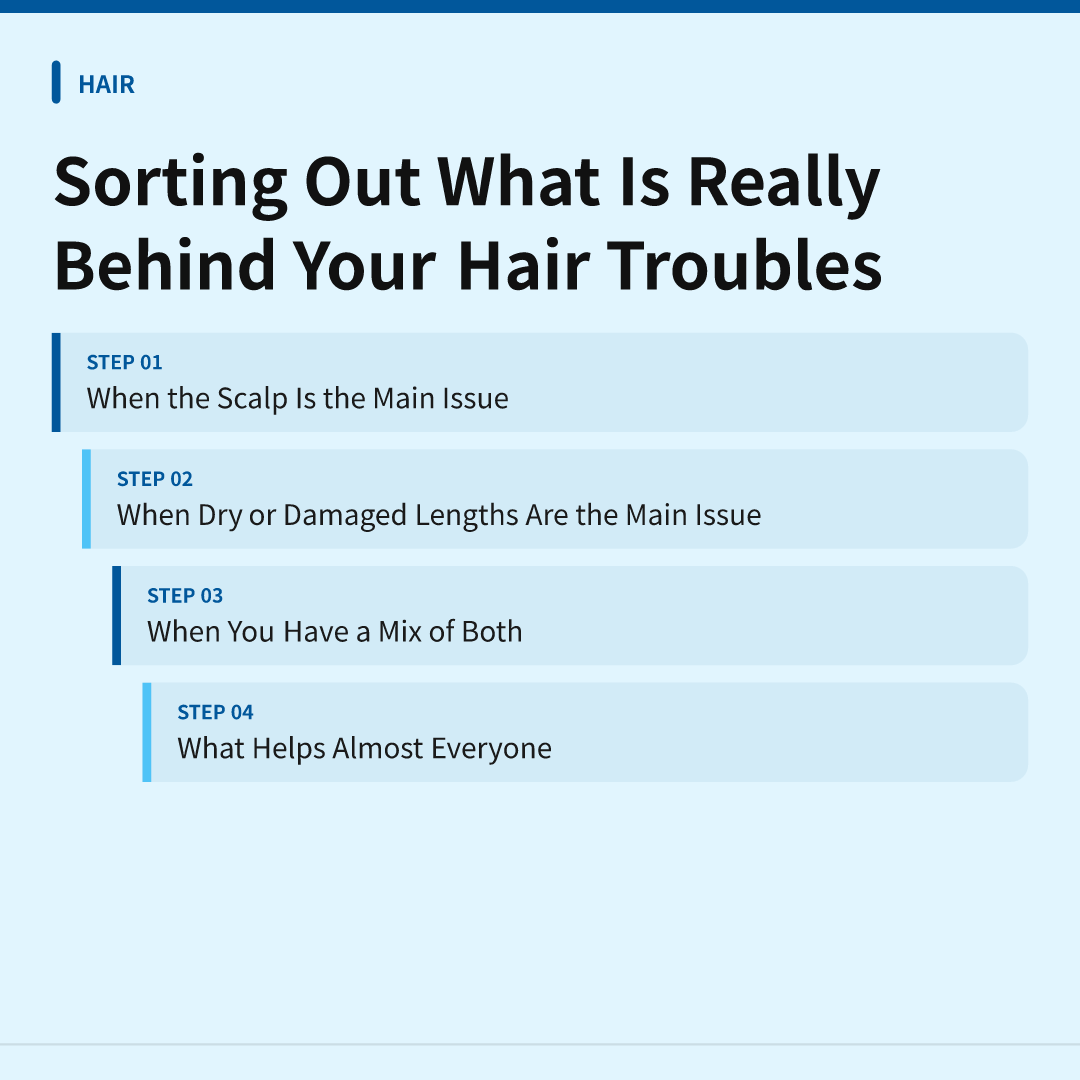
Before you plan anything, it helps to separate the scalp from the hair lengths. The scalp is skin, and it produces oil. The lengths, meaning the part of the hair that extends beyond the scalp, are not living tissue and cannot repair themselves the way skin does. Many routines go wrong because they treat the two as one thing.
Three common patterns
- Scalp-driven: roots look greasy soon after washing, while the ends feel fine. Itching or flaking can show up here too.
- Length-driven: the scalp feels comfortable, but the mid-lengths and ends are dry, rough, frizzy, or tangle easily.
- Mixed: oily roots with dry ends, which is very common in longer hair or hair that is colored or heat styled.
Your hair type, texture, climate, activity level, and styling habits all play a part. Tightly coiled hair, for example, often behaves differently from fine straight hair, since natural oils travel down the strand less easily. That is one reason there is no single universal calendar.
A quick way to observe before you change anything
Spend a week or two noticing patterns rather than adjusting products. Notice how soon the roots feel oily after a wash, whether the ends feel straw-like, and whether anything stings, itches, or flakes. Jot a few notes on your phone if that helps. This small step often saves you from buying products aimed at the wrong issue.
When the Scalp Is the Main Issue
How to tell if this is your case
If your roots feel oily or heavy within a day or so of washing, and your ends feel reasonably soft, the scalp is likely the lead character. You may also notice that hair looks flat at the crown but behaves better toward the tips. Sweat from workouts, humid weather, and heavy styling products can all add to that buildup.
Itchiness, visible flakes, redness, or tender patches deserve a little more caution. Those signs can come from several different causes, including dandruff, product sensitivity, or other skin conditions. The American Academy of Dermatology general guidance describes dandruff and scalp irritation as common, and also notes that persistent or worsening symptoms are worth having a professional look at.
What a scalp-focused week often looks like
People with oily scalps commonly build their week around more frequent cleansing, focusing shampoo on the scalp rather than the lengths. Conditioner then goes mainly on the mid-lengths and ends. Many also schedule a periodic clarifying wash to deal with product buildup, though how often that suits you depends on your hair and the product's own label.
- Cleansing days are spaced to match how quickly your roots get oily, not to match a trend.
- Heavy oils and rich masks tend to stay away from the roots.
- Dry shampoo is often used as a short bridge between washes, though layering it day after day can contribute to buildup.
If you are considering a medicated shampoo for flaking or itching, the right type and how often to use it varies by product and by person. Check the label and ask a pharmacist or doctor before settling on one.
The cost of guessing wrong
If you treat a dry-length problem with frequent clarifying washes, you can leave the ends rougher than before. On the other hand, if you skip washing to "let the scalp balance itself" while it is truly oily and itchy, the discomfort may drag on. The scalp-versus-lengths check above is worth the few minutes it takes.
When Dry or Damaged Lengths Are the Main Issue
How to tell if this is your case
If your scalp feels comfortable for several days but the ends look dull, snap easily, or form tangles and knots, the lengths are probably asking for attention. Color treatment, bleaching, frequent heat styling, tight hairstyles, and rough towel drying are common contributors. The American Academy of Dermatology general guidance notes that heat and chemical processing can weaken hair over time, which is why styling habits matter as much as products.
What a length-focused week often looks like
A routine for dry or processed hair usually spaces out washes a bit more and puts the emphasis on conditioning, gentle handling, and heat management. Here is how people often structure it:
- Wash days: shampoo is concentrated on the scalp, with conditioner worked through the lengths.
- Mask or deep conditioning day: a richer conditioning product is used on a set day, based on the product's directions.
- Leave-in or light finishing products: these are often used after washing to help with softness and tangles.
- Heat-free days: some days are kept free of hot tools to give hair a break.
Conditioning products can make hair feel softer and look smoother, but they do not rebuild a damaged strand. Results vary by hair type, and most improvement comes from reducing the ongoing causes of damage over time.
The cost of guessing wrong
Piling on masks when the real issue is scalp buildup can leave hair limp and greasy. And if breakage is actually coming from tension hairstyles or rough brushing, no amount of conditioner will fully offset it. Look at your habits, not only your shelf.
When You Have a Mix of Both
Oily roots with dry ends are one of the most common combinations, particularly in longer or colored hair. The approach is to treat the two zones differently within the same week. Cleansing targets the scalp, while conditioning and treatments stay mostly below the ears.
Some people assign each day a job: a wash day, a conditioning day, and a rest day with minimal products. That structure keeps the plan simple enough to follow. If you find yourself adjusting constantly, it is usually a sign to simplify rather than add more steps.
What Helps Almost Everyone
Whatever the cause, a few habits tend to support a weekly schedule regardless of hair type. None of these are cures, and none promise a particular outcome, but they are widely used for good reasons.
Keep the plan simple and consistent
A realistic schedule is one you can actually follow when you are tired or busy. Fewer steps, used regularly, often beat an elaborate plan that collapses after a week. Pick fixed days for washing and for any extra treatment, and let the other days be easy.
Give changes time
Hair and scalp respond gradually. Changing products every few days makes it hard to tell what is helping or irritating you. Many people find it more useful to adjust one thing at a time and watch for changes over several weeks.
Be gentle with wet hair
Wet hair is generally more fragile, so detangling with care, starting from the ends, and avoiding harsh towel rubbing are common suggestions. Loose styles on non-wash days also reduce pulling on the scalp and roots.
Patch awareness for new products
Any new hair or scalp product can cause a reaction in some people, and reactions vary from person to person. Fragrance, preservatives, and some dyes are frequent triggers. If a product stings, burns, or causes a rash, stopping it and speaking with a pharmacist or doctor is the sensible move. Follow the product label rather than guessing at how it should be used.
heat styling habits and hair damageAdjust for life, not just hair
Workouts, swimming, seasonal humidity, and travel all shift how your hair behaves. A good weekly schedule has room to flex. For example, someone who exercises often may add a wash day, while someone in a dry climate may lean harder on conditioning.
When to Talk to a Professional
A schedule can only do so much. The National Institutes of Health general guidance on hair loss notes that many people lose some hair each day, but sudden, patchy, or unusual shedding can have medical causes worth discussing with a clinician. Similarly, a scalp that is persistently painful, very red, scaly, or crusted should be looked at rather than managed by trial and error.
- Hair thinning that is noticeable, rapid, or in patches
- Scalp pain, sores, swelling, or oozing
- Itching or flaking that does not settle despite a steady routine
- Reactions after using a new product or dye
A dermatologist or other licensed professional can help sort out the cause and recommend what fits your situation. A hairstylist can also be a useful partner for questions about cuts, color, and texture, though they are not a substitute for medical care when symptoms are concerning.
Putting It All Together
If your scalp is the problem, a weekly plan leans on well-timed cleansing and keeps heavy products off the roots. If the lengths are dry or damaged, the plan shifts toward conditioning, gentler handling, and fewer hot-tool days. When both are true, you treat the roots and the ends as separate zones within the same week. Across all three, simplicity, patience, and attention to how your hair responds do more than any single product.
If you cannot tell which pattern fits, there are reasonable options. You can observe for a couple of weeks with a basic routine, ask a stylist to assess your hair's condition in person, or see a dermatologist if scalp symptoms are involved. Whichever route you take, the best way to build a weekly hair care schedule is to start with the cause, keep the plan flexible, and adjust gradually as your hair tells you what it needs.
Disclaimer: This article is for informational purposes only and is not a substitute for professional medical advice, diagnosis, or treatment. Please consult a licensed professional for personal health decisions.