How to Read a Shampoo Ingredient List Without Feeling Lost
Learning how to read a shampoo ingredient list starts with one idea: the label is a roster of what is in the bottle, not a report card. Ingredients are generally listed from the largest amount to the smallest, and most of what sits near the top is water and cleansing agents. Once you can sort the long names into a few familiar groups, the label becomes far less intimidating.
If you have ever stood in a store aisle squinting at words like "sodium laureth sulfate" or "phenoxyethanol," you are in good company. Product pages, social media posts, and salon conversations all throw around terms as if everyone already knows them. This guide translates the most common ones in three steps each: the plain-language meaning, why it matters, and the misunderstanding people often have. I am writing as a beauty information editor, not a clinician, so nothing here is personal medical advice.
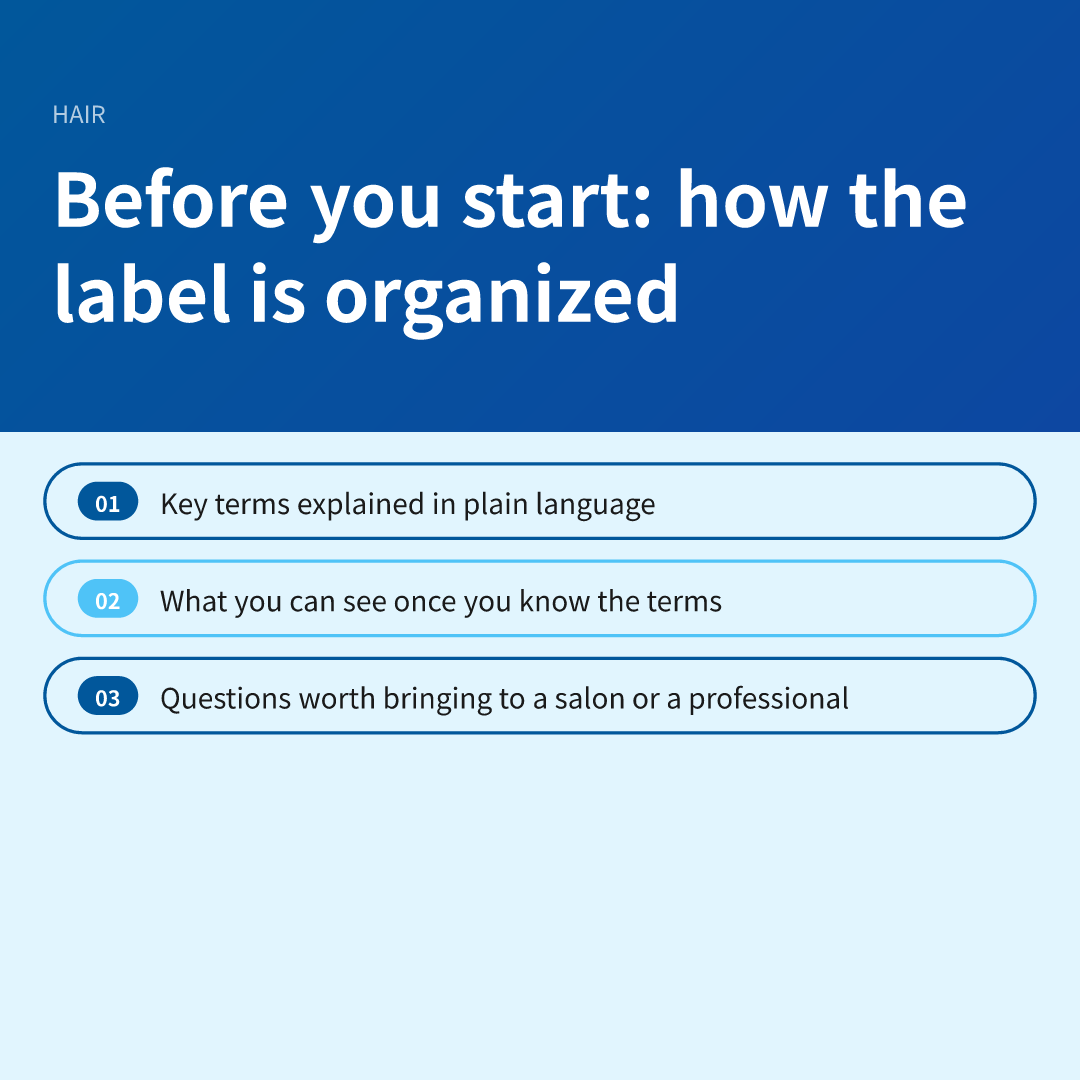
Before you start: how the label is organized
In the United States, the FDA explains that cosmetic ingredients are generally listed in descending order of predominance. That means the first few entries make up most of the formula. Ingredients present in very small amounts can sit toward the end, and the order among those tiny amounts may not reflect real differences in quantity.
Another point worth knowing: a shampoo's front label is marketing, while the back label is the ingredient list. Words like "gentle," "clean," or "nourishing" on the front are not the same as a regulated description of what is inside. The ingredient list is the more reliable place to look, and you will often see it printed in very small type.
Key terms explained in plain language

Water (Aqua)
Plain meaning: It is simply water, and it usually appears first. Why it matters: It is the base that carries everything else, so a long list of exciting ingredients after it does not mean those ingredients are present in large amounts. Common misunderstanding: People sometimes treat water as filler to be avoided, but most liquid shampoos need a water base to work as designed.
Surfactants (the cleansing agents)
Plain meaning: These are the ingredients that let shampoo lather and lift away oil, product buildup, and dirt. Names you may see include sodium laureth sulfate, sodium lauryl sulfate, cocamidopropyl betaine, and decyl glucoside. Why it matters: Surfactants largely determine how strongly a shampoo cleans and how it feels on the scalp. Some people with dry or sensitive scalps find stronger cleansers uncomfortable, while others with very oily hair prefer them. Common misunderstanding: "Sulfate" is often presented online as automatically harmful. In reality, how a cleanser feels depends on the whole formula, the concentration, and your own scalp and hair, so reactions vary from person to person.
Conditioning agents (silicones, quaternium compounds, fatty alcohols)
Plain meaning: These help hair feel smoother and easier to comb. Dimethicone and amodimethicone are silicones, polyquaternium ingredients are positively charged conditioners, and cetyl or stearyl alcohol are fatty alcohols. Why it matters: They influence slip, softness, and how weighed down hair may feel. Common misunderstanding: "Alcohol" on a label does not always mean the drying kind. Fatty alcohols such as cetyl alcohol are waxy and are commonly used in conditioning products, which is quite different from the short-chain alcohols people tend to worry about.
Preservatives
Plain meaning: These keep bacteria, yeast, and mold from growing in a water-based product. Examples include phenoxyethanol, sodium benzoate, and potassium sorbate. Why it matters: A shampoo that sits in a warm, humid shower needs some protection to stay usable. Common misunderstanding: A "preservative-free" claim is not automatically better. Water-containing products without adequate preservation can be a concern, and some people who react to one specific preservative may do well with another. If you suspect a reaction, a dermatologist can help sort out the cause.
Fragrance (Parfum)
Plain meaning: A scent blend that can be made of many individual components. Why it matters: Fragrance is a common trigger for scalp or skin irritation in people who are prone to sensitivity. On many labels it appears as one word even though it may represent several ingredients. Common misunderstanding: "Natural" or essential-oil scents are not automatically gentler. Plant-derived fragrance components can irritate some people just as synthetic ones can.
Humectants and moisturizers
Plain meaning: Ingredients like glycerin, panthenol, and propylene glycol attract or hold water. Why it matters: They contribute to the feel of the product and may help hair feel softer. Common misunderstanding: A shampoo is rinsed off within minutes, so it is realistic to expect modest effects from these ingredients rather than the lasting moisture of a leave-in product.
pH adjusters and thickeners
Plain meaning: Citric acid, sodium hydroxide, sodium chloride, and similar entries fine-tune acidity and texture. Why it matters: They help the product stay stable and feel pleasant to use. Common misunderstanding: Seeing a base like sodium hydroxide can sound alarming, but in a finished product it is typically used in tiny amounts to balance the formula.
Active ingredients in treatment shampoos
Plain meaning: Dandruff-oriented shampoos may list ingredients such as zinc pyrithione, selenium sulfide, ketoconazole, or salicylic acid. Why it matters: In the U.S., products that make dandruff claims are generally regulated as over-the-counter drugs, and their labels include a separate "Drug Facts" panel. Common misunderstanding: These are not interchangeable with everyday shampoos. How often they are used and for how long should come from the product label, a pharmacist, or a doctor, not from a general article like this one.
What you can see once you know the terms

With the vocabulary above, a label starts to tell a story. Look at the first handful of ingredients: if you see water followed by one or two surfactants, you are looking at the cleansing backbone of the formula. Conditioning ingredients, scent, and preservatives usually come after that, and the botanical extracts that show up in big letters on the front often appear far down the list.
That last point is useful for evaluating marketing. If a bottle highlights a plant extract on the front but the extract appears near the end of the list, it is probably present in a small amount. That does not make it useless, but it does help you keep expectations realistic.
You can also spot patterns that matter for your own hair. People with fine hair sometimes find heavy conditioning agents weigh their hair down, while people with coarse or curly hair often look for richer conditioning. Someone with a sensitive scalp may pay closer attention to fragrance and certain preservatives. None of this is a rule; it is simply a way to connect what is printed on the bottle to what you have noticed about your own hair over time.
Limits of label reading
An ingredient list cannot tell you everything. It does not show exact percentages, how ingredients interact, or how a formula was tested. Two shampoos with nearly identical lists can feel quite different. And a list cannot predict whether you personally will react to something.
If you have a scalp that is persistently itchy, flaky, painful, or red, or if you notice hair shedding that worries you, a label alone is not the answer. According to the American Academy of Dermatology's general guidance, persistent scalp or hair concerns are worth discussing with a board-certified dermatologist, who can look at the underlying cause.
Questions worth bringing to a salon or a professional

Whether you are talking with a stylist, a pharmacist, or a dermatologist, specific questions get more useful answers than "what is the best shampoo?" Here are some that tend to work well.
- "Based on my hair type and scalp, what kind of cleanser strength might suit me?" This opens a conversation about surfactants without requiring you to know the names.
- "Are there ingredients I should be cautious about given my history of irritation?" Mention any past reactions to fragrance, dyes, or other products.
- "How would I know whether this is a cosmetic shampoo or a medicated one?" A pharmacist can explain the difference and what the Drug Facts panel means.
- "Could my styling products or hard water be affecting how my hair feels?" Sometimes the shampoo is not the main factor.
- "Is a patch test a reasonable idea for me before I try something new?" A professional can tell you whether and how to do this for your situation.
If you are using any medicated product, ask the pharmacist or doctor how it fits into your routine, since the right approach depends on the product and the person. Please follow the product's own directions and professional guidance rather than general internet advice.
A note on "free-from" claims
Labels that say "sulfate-free," "paraben-free," or "silicone-free" describe what is absent, not whether the shampoo is better for you. These claims are common marketing language, and the replacement ingredients have their own characteristics. It can help to ask what the product uses instead, and whether that suits your hair, rather than treating the absence of one ingredient as a sign of quality.
Frequently asked questions
Is it embarrassing that I cannot pronounce most of the ingredients?
Not at all. Most ingredient names follow a standardized naming system rather than everyday language, so they look strange to almost everyone at first. You do not need to pronounce them, only to recognize the categories, such as cleanser, conditioner, preservative, and fragrance.
Does a short ingredient list mean a shampoo is gentler?
Not necessarily. A short list can still contain a strong cleanser or a fragrance that bothers a particular person, and a long list can include mild, well-tolerated ingredients. Reactions vary from person to person, so the full formula and your own history matter more than the length alone.
If a long chemical name sounds scary, should I avoid it?
A complicated name is not a reliable sign of risk. Many ordinary substances, including ones found in food and nature, have long scientific names. If a specific ingredient worries you, ask a pharmacist or dermatologist about it rather than relying on social media lists.
Why does the same shampoo feel different to me than it does to my friend?
Hair texture, scalp oil levels, water hardness, styling habits, and sensitivity all differ between people. A formula that feels light and clean to one person can feel stripping or heavy to another. This is why trying to read a shampoo ingredient list is a helpful starting point but never a guarantee of how a product will perform for you.
Disclaimer: This article is for informational purposes only and is not a substitute for professional medical advice, diagnosis, or treatment. Please consult a licensed professional for personal health decisions.
Related reading: How to Wash Your Hair Without Stripping It