What Silicones in Conditioner Do, and How to Read the Label
Silicones in conditioner mostly work as a smoothing, slip-adding coating on the hair surface, which is why strands often feel softer and detangle more easily. Let's read the back of a bottle together, because that small block of ingredients explains most of what you feel in the shower and after. Once you know which names to look for and what they tend to do, a conditioner label stops being a wall of chemistry and starts being useful.
This is general beauty information, not personal advice. Hair, scalp, and water conditions vary a lot, so treat what follows as a way to read labels more confidently rather than a rule about what you should buy.
What to look for on the ingredient label
Ingredients on cosmetic products in the United States are generally listed in descending order of amount, according to the U.S. Food and Drug Administration's cosmetic labeling guidance. That means a silicone near the top of the list is likely a bigger part of the formula than one tucked in at the end. It is a rough guide only, since the label does not give exact amounts.
Names that signal a silicone
Silicone ingredients usually carry names ending in "-cone," "-conol," or "-siloxane." You will often see dimethicone, amodimethicone, cyclopentasiloxane, and dimethiconol. Some labels use a longer chemical name with "PEG" or "PPG" attached, such as PEG-12 dimethicone.
What it means: these are synthetic, silicon-based ingredients that spread into a thin, flexible film. In conditioners they are commonly used to reduce friction between strands, add shine, and make hair feel slick.
Common mix-up: people sometimes assume "silicone" means a single ingredient. It is actually a family, and different members behave quite differently, which the next sections cover.
Dimethicone and its relatives
What it means: dimethicone is one of the most widely used silicones in hair care. It tends to form a smooth coating that helps hair glide past other strands and past a comb, and it can reduce the look of frizz by calming a rough surface.
Common mix-up: some readers think a dimethicone-containing conditioner is automatically heavy. How heavy it feels depends on the specific silicone, its amount, and what else is in the formula, so the name alone does not settle it.
Amodimethicone and the "conditioning" silicones
What it means: amodimethicone is a modified silicone with a slight attraction to damaged or rough hair surfaces. It is often described as targeting areas where the hair's outer layer is more worn, which is one reason formulators use it in smoothing and repair-style products.
Common mix-up: "modified" does not mean it never builds up. Reactions and residue vary with hair type, how much product is used, and how often it is washed out.
Cyclic silicones
What it means: cyclomethicone and cyclopentasiloxane are lighter, more volatile silicones. They tend to help a product spread and then evaporate, leaving a smooth feel without as much lasting film.
Common mix-up: because they evaporate, some people assume they are the same as a leave-on coating. In practice they often act as a carrier that helps other ingredients distribute evenly.
Water-soluble and modified silicones
What it means: silicones with "PEG" or "PPG" in the name are altered so they dissolve or disperse in water more readily. They are generally associated with rinsing out more easily than standard dimethicone.
Common mix-up: "water-soluble" does not guarantee zero residue for every hair type. Hard water, other styling products, and hair texture all influence how clean hair feels afterward.
Related reading: How to Read a Shampoo Ingredient List Without Feeling Lost
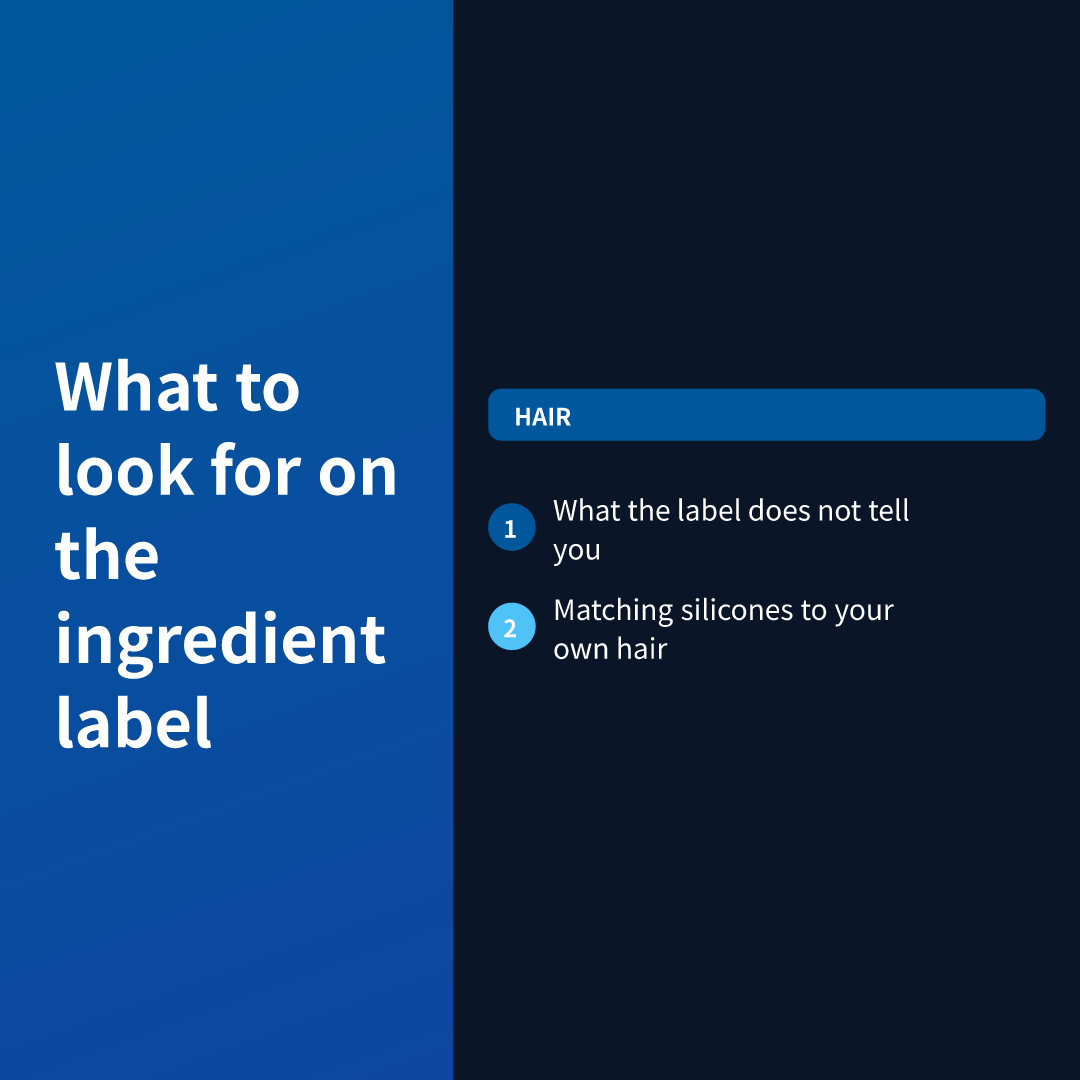
What the label does not tell you
An ingredient list is useful, but it leaves out several things that matter as much as the names themselves. Reading it well means knowing where its limits are.
How much is in the bottle
Labels show order, not quantity. Two conditioners can both list dimethicone and feel completely different because one contains a small amount and the other makes it a central ingredient. Sometimes a silicone appears low on the list and still shows up in how the product feels, because it takes only a little to change slip.
How the whole formula behaves
A silicone does not work alone. Fatty alcohols, oils, humectants, and conditioning agents all shape the final feel. A formula with several rich ingredients may feel heavy even without much silicone, and a light formula may feel airy even with one.
Whether it builds up on your hair
You will often hear that silicones "build up." Many beauty educators describe this as a possible effect where repeated coating may leave some hair feeling weighed down, dull, or less able to absorb moisture. Whether that happens, and how quickly, depends on the type of silicone, hair texture, porosity, wash frequency, and what else you use. The label cannot predict it for you.
What silicones do not do
Silicones are a surface treatment. They can make hair look and feel smoother and may offer a degree of protection from friction, but they do not repair the internal structure of damaged hair, and they do not change how hair grows. Any smoothing is cosmetic and tends to fade as the coating is washed away.
On the scalp side, the FDA notes that cosmetics are not meant to treat disease. If you have persistent itching, flaking, redness, or hair loss, that is a question for a licensed professional rather than something an ingredient swap can settle.
The sulfate and washing connection
Whether silicone residue lingers often depends on the shampoo as much as the conditioner. Some people use a stronger cleansing shampoo now and then to remove accumulated product, while others find their regular shampoo is enough. Gentle formulas and strong clarifying ones can sit anywhere along that range, so the right match is individual. If you are unsure, a hairstylist or dermatologist can talk through your routine.
Matching silicones to your own hair
The same ingredient can be a help for one person and a nuisance for another. Think of the following as general patterns that many people report, not predictions.
Fine or easily weighed-down hair
Fine hair can look flat when it carries a lot of coating. Many people with this hair type prefer lighter formulas, or they pay attention to how much product sits on the lengths versus the roots. That said, some find a small amount of a light silicone helps with tangles, so it is worth noticing how your own hair responds.
Thick, coarse, or frizz-prone hair
Thicker or frizz-prone hair often tolerates and even likes the slip silicones provide, especially for combing through wet hair. The tradeoff some people notice is dullness or a stiff feel if residue accumulates, which usually becomes obvious over time rather than after one wash.
Curly and coily hair
Opinions here are mixed. Some people with curly or coily hair avoid silicones because they worry about moisture getting blocked, while others rely on them for detangling and frizz control. Hair care communities discuss this at length, but individual results differ, and neither choice is universally right.
Color-treated, heat-styled, or damaged hair
Hair that has been lightened, colored, or heat-styled often has a rougher surface, so a smoothing coating can feel noticeable. Silicones may add shine and reduce snagging, but they do not rebuild the hair. If breakage is a concern, a stylist can assess the actual condition of your hair.
Sensitive or reactive skin
Silicones are generally described as common in cosmetics, but any ingredient, fragrance, or preservative in a conditioner can bother some scalps. Reactions vary from person to person. If you notice stinging, redness, or a rash, stop using the product and consider speaking with a licensed professional, particularly if symptoms continue. Before using a new product, a patch test as described on the label or by your clinician can help you spot trouble early.
Related reading: What Does Hair Conditioner Actually Do to Your Hair?
Preference matters too
Not everyone cares about the same things. Some people want maximum slip and shine, others want a product that rinses clean and feels light. Silicone-free conditioners exist and work for many people, while others are happy with silicone-containing ones. Neither is a moral choice, and it can help to change one product at a time so you can tell what made the difference.
Frequently asked questions
Are silicones the same as plastic or wax on the hair?
No, they are a different class of ingredient, although people often describe the coating effect in those terms because it sits on the hair surface. Silicones are flexible, synthetic polymers, and their behavior depends on the specific type. The comparison is an everyday shorthand, not a technical description.
Do I need to avoid silicones if I have an itchy or flaky scalp?
Not necessarily, because itching and flaking have many possible causes that a conditioner label cannot sort out. Conditioners are generally applied to the lengths of the hair, so a scalp problem may relate more to shampoo, other products, or an underlying skin condition. A dermatologist or other licensed professional can evaluate persistent symptoms.
Can silicone-free conditioner still make hair feel slippery?
Yes, because other ingredients such as fatty alcohols, cationic conditioning agents, and certain oils also create slip and softness. The feel may be different, often described as less glossy or less coated, but many people find it entirely satisfactory. Trying one product at a time helps you see the difference.
How can I tell if my conditioner is building up on my hair?
Some people notice hair that looks dull, feels limp or waxy, or seems to resist moisture and styling over time, though these signs can also come from other products, water minerals, or hair damage. Because the causes overlap, it is hard to pin down from appearance alone. If you are unsure, a stylist can look at your hair and routine and talk through options.
One last check before you buy: look at your hair's current needs and the first handful of ingredients, then decide whether what silicones in conditioner do, such as adding slip and smoothness, is what you actually want from this bottle.
Disclaimer: This article is for informational purposes only and is not a substitute for professional medical advice, diagnosis, or treatment. Please consult a licensed professional for personal health decisions.