How to Switch Shampoos Without a Bad Week
Two people can switch shampoos and both say their hair feels awful, yet the reasons behind it may be completely different. Knowing how to switch shampoos without a bad week starts with figuring out what is actually going wrong: leftover buildup from the old product, a scalp that dislikes something in the new one, or hair that is simply reacting to a different cleansing style. Each cause calls for a different response, and guessing wrong tends to waste time and money.
This guide walks through the main reasons a shampoo change can feel rough, how to tell them apart, and what generally helps in each case. It also covers the limits of at-home troubleshooting and when it makes sense to bring in a professional.
Why a Shampoo Change Can Feel Rough in the First Place
Hair and scalp do not read ingredient lists, but they do respond to what a product leaves behind or takes away. A new formula may cleanse more strongly or more gently than the old one. It may deposit different conditioning agents, or include a fragrance or preservative your skin does not like. Any of these can change how hair looks and feels within a few washes.
The tricky part is that very different problems look alike from the mirror. Limp, greasy-looking hair, an itchy scalp, flakes, and frizzy ends can all show up after a switch, and they do not all mean the same thing. Sorting them into rough causes is the most useful first step.
Three common causes worth separating
- Residue and buildup: the new shampoo is not removing what the old routine left behind, or the new product itself leaves a film.
- Scalp irritation or sensitivity: an ingredient is bothering the skin, which may show up as itching, stinging, redness, or tenderness.
- Adjustment to a different cleansing strength: the formula is stronger or milder than what your hair was used to, so oil balance and texture feel off for a while.
These can overlap. Still, one tends to dominate, and the clues below help you spot which.
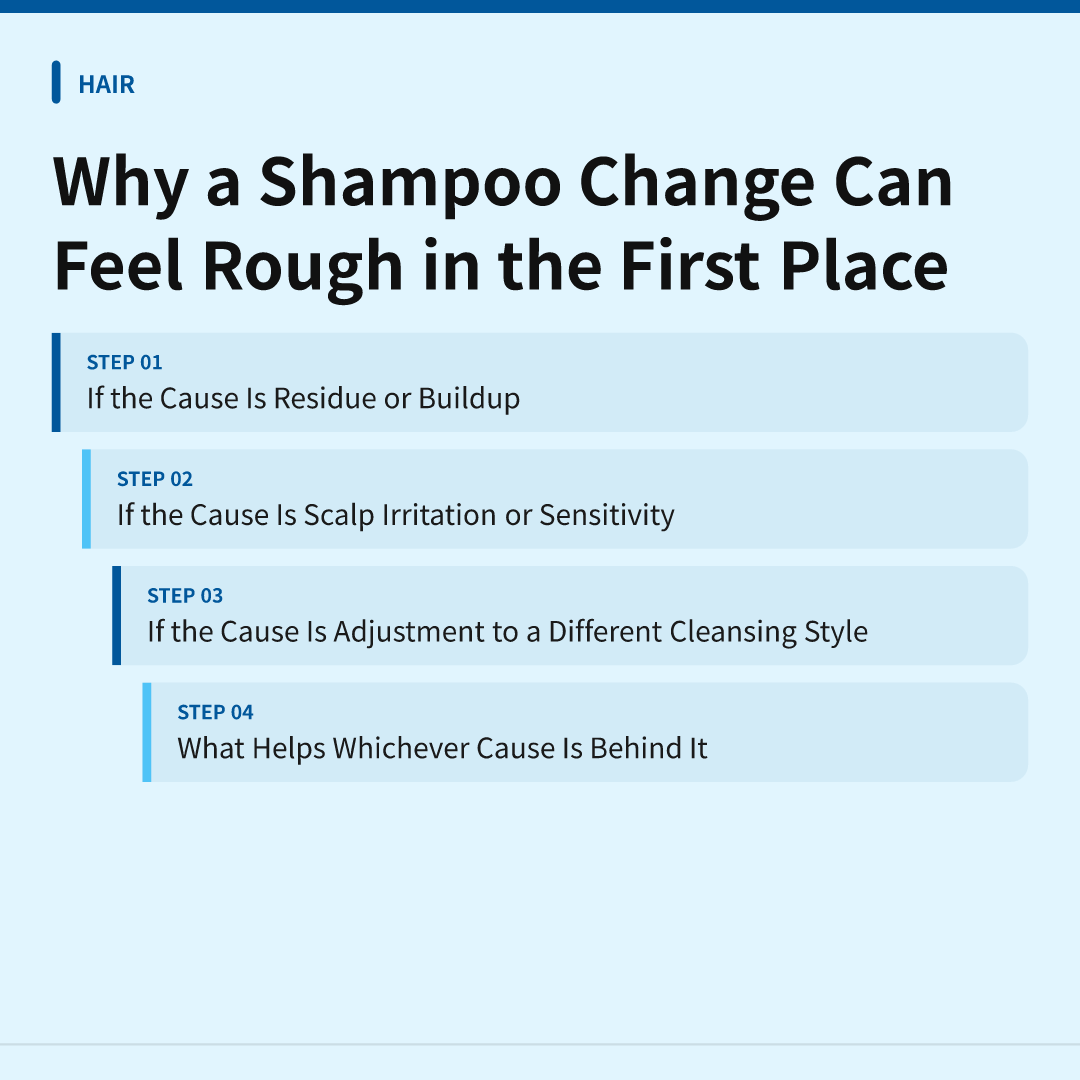
If the Cause Is Residue or Buildup
How to tell if this is your situation
Buildup often makes hair feel coated, heavy, or strangely dull. Strands may look flat at the roots even right after washing, and styling products may seem to stop working the way they used to. Hair can feel waxy or slightly tacky rather than clean. Scalp discomfort, if any, is usually mild.
Buildup is more likely if you previously used rich conditioners, silicone-heavy products, oils, dry shampoo, or lots of styling products. It can also happen if you live in an area with hard water, since minerals can leave their own kind of film on hair. Switching from a cream-like shampoo to a lightweight one, or the other way around, may make leftover layers more noticeable.
What generally helps if it fits
When residue is the issue, a thorough rinse and a more careful look at the whole routine often matter more than the shampoo name. Many people find that the old product's leftovers need a few washes to clear, and that giving the new shampoo enough time to lather and rinse well makes a visible difference. Some people use a clarifying shampoo occasionally for this purpose, but how often is a question for the product label or a stylist, since clarifying formulas can be drying for some hair types.
It also helps to look at what else touches your hair. A new shampoo cannot fix a heavy leave-in, a daily oil, and a thick conditioner applied near the scalp. Simplifying for a short stretch can reveal whether the shampoo was ever the problem.
What goes wrong if you guessed wrong
If the real issue is scalp irritation and you assume it is buildup, stronger cleansing can make things worse. Clarifying or deep-cleansing products can be harsh on a sensitive scalp, and you may end up with more itching and dryness than you started with. If your scalp feels sore or looks red, treat that as a reason to pause rather than scrub harder.
If the Cause Is Scalp Irritation or Sensitivity
How to tell if this is your situation
Irritation tends to announce itself on the skin rather than in the hair. Signs people commonly report include itching, burning, stinging, tightness, redness, small bumps, or increased flaking soon after starting a new product. The timing is a clue: if the discomfort began within a few washes of the switch and was not there before, the new formula becomes a reasonable suspect.
Fragrance, certain preservatives, strong surfactants, and some botanical extracts are ingredients that sometimes bother sensitive skin, though reactions vary a lot from person to person. According to the American Academy of Dermatology Association's general guidance, products labeled gentle or fragrance-free are often chosen by people with sensitive skin, but labels alone do not guarantee that a product will suit you.
What generally helps if it fits
If a product seems to be irritating your scalp, many people stop using it and return to the shampoo that was previously comfortable while things settle. Reintroducing the new product later, or trying a different formula with a shorter ingredient list, is a common way to narrow down the culprit. Writing down what you used and when can make patterns easier to see.
Avoid layering on several new products at once while sorting this out. When three things change together, it becomes nearly impossible to know which one caused the reaction.
When this needs a professional
Persistent itching, painful or spreading redness, oozing, crusting, noticeable hair shedding, or a rash that reaches the face, ears, or neck deserves a conversation with a dermatologist or other licensed clinician. Scalp conditions such as dandruff, seborrheic dermatitis, psoriasis, and allergic contact reactions can look similar at home but are managed differently, and a clinician is the right person to sort them out. Medicated shampoos in particular should be used according to the product directions and with guidance from a pharmacist or doctor.
What goes wrong if you guessed wrong
Treating irritation as a simple adjustment period can mean pushing through weeks of discomfort for no reason. Waiting it out is reasonable for mild, fading changes in oiliness or texture. It is not a good plan for burning, swelling, or worsening itch.
If the Cause Is Adjustment to a Different Cleansing Style
How to tell if this is your situation
This pattern is the most common in ordinary switches and the least dramatic. The scalp feels comfortable, with no real itching or burning, but the hair behaves differently. It may feel oilier for a few days, drier at the ends, a little rougher, or harder to style the way you like. Switching from a stripping formula to a milder one can briefly feel like the hair is not getting clean, while switching to a stronger formula can feel tight or squeaky.
Hair type matters here. Fine hair tends to show oil and heaviness quickly. Thick, curly, or coily hair is often drier by nature and can react to stronger cleansers with more frizz or tangling. Color-treated or chemically processed hair may respond differently still, since it is already more fragile.
What generally helps if it fits
A short period of patience is often the whole answer. Many people give a new shampoo several washes before deciding, because the first one or two may be influenced by whatever remains from the previous routine. A gentle transition can help too: some people alternate the old and new shampoo for a little while rather than changing abruptly. Whether that suits you depends on your hair and the products involved.
Pay attention to how much product you use and where it goes. Shampoo is generally meant for the scalp, where oil and debris collect, while the lengths of the hair get cleansed as the suds rinse through. Conditioner usually matters more for the ends. If a new shampoo feels drying, adjusting the conditioner and the rest of the routine may help more than another switch.
What goes wrong if you guessed wrong
If you assume the rough patch is just adjustment but the real issue is irritation, you may ignore warning signs. On the other hand, if you assume the shampoo is failing and keep swapping products every few days, you never give any of them a fair trial, and you may add more residue and confusion in the process. Constant switching is a common reason people feel stuck in a bad hair cycle.
What Helps Whichever Cause Is Behind It
Some habits make nearly any shampoo transition smoother, regardless of what is driving the rough patch.
Change one thing at a time
Switching shampoo, conditioner, styling product, and washing frequency all in the same week makes it impossible to read the results. Moving just the shampoo, and holding everything else steady, gives you a clear signal about whether it suits you.
Check the ingredient list before you buy
If your scalp has reacted to something before, scanning the label for that ingredient is a simple step. Labels can be confusing, and marketing words such as natural, clean, or gentle do not have a single fixed meaning. A product's full ingredient list is more informative than its front-of-bottle claims.
Rinse thoroughly and be mindful of water
Incomplete rinsing leaves product on the scalp, which can mimic or cause the very problems people blame on a new shampoo. Very hot water can also be uncomfortable for a sensitive scalp. Comfortable, lukewarm water is a common preference, though individual comfort varies.
Give it a fair window, within reason
- Mild changes in oiliness or texture often settle as hair adjusts.
- Discomfort that is getting worse is a signal to stop, not to push through.
- If nothing improves after a reasonable trial, the product may simply not suit your hair.
Know the limits of a switch
A shampoo is a cleansing product. Cosmetic shampoos are generally meant to clean hair and scalp and improve how hair looks and feels, not to resolve medical scalp or hair-loss conditions. If hair thinning, patchy shedding, or persistent scalp symptoms are the reason you are switching, the shampoo alone is unlikely to be the full story. A dermatologist can help look at underlying causes. The U.S. Food and Drug Administration distinguishes between cosmetics and drugs based on intended use, which is one reason medicated shampoos have their own labeling and directions.
Putting It Together
Working out how to switch shampoos without a bad week mostly comes down to reading the clues. If hair feels coated, heavy, or dull but the scalp is calm, leftover residue is a likely suspect, and a thorough rinse plus a simpler routine tends to be the sensible direction. If the scalp itches, stings, reddens, or flakes soon after the change, irritation is more likely, and stepping back to a product you tolerated while you narrow down the trigger is a common approach. If the scalp feels fine but hair simply behaves differently, you are probably looking at an adjustment period, and a few patient washes or a gradual transition often smooths it out.
When it is hard to tell which situation you are in, you have a few reasonable options. You can go back to your previous shampoo for a while and then reintroduce the new one on its own. You can ask a hairstylist about buildup, hard water, and how your hair type tends to respond. Or, if symptoms are strong, lasting, or getting worse, you can book a visit with a dermatologist or other licensed clinician, who can look at your scalp directly. Reactions vary from person to person, so the aim is not a perfect formula on the first try but a switch that is easy to read and easy to reverse.
Disclaimer: This article is for informational purposes only and is not a substitute for professional medical advice, diagnosis, or treatment. Please consult a licensed professional for personal health decisions.
Related reading: How to Read a Shampoo Ingredient List Without Feeling Lost