Sulfate Free Shampoo Explained in Plain Terms
Walk down any hair care aisle and the phrase "sulfate free" is almost impossible to miss. It shows up on bottles for curly hair, color-treated hair, sensitive scalps, and plenty of shoppers who simply want a gentler wash. The label has become a kind of shorthand, and like most shorthand, it leaves a lot unsaid.
Sulfate free shampoo is a cleanser that skips the strong, high-foaming detergents such as sodium lauryl sulfate and sodium laureth sulfate, and uses milder cleansing agents instead. It usually lathers less and may feel softer on the hair, though how it performs depends on the formula and on the person using it. Below is a plain-language look at what that means, who may notice a difference, and where the marketing gets ahead of the facts.
Where the Sulfate Free Label Comes From
Shampoo has one basic job: lift away oil, product residue, sweat, and everyday grime so they can be rinsed off. To do that, formulas rely on surfactants, which are ingredients that bind to both oil and water. Sulfates are one family of surfactants, and they have been popular for a long time because they clean well, foam generously, and are inexpensive to produce.
The conversation shifted as more people started paying attention to ingredient lists. Curly and coily hair communities, people who color their hair, and people with easily irritated skin began asking whether a strong cleanser was the right fit for them. Brands responded with a wide range of milder formulas, and "sulfate free" became a marketing banner that is easy to understand at a glance.
It is worth saying plainly that the label is a description of what a product leaves out, not a promise of what it does. A bottle can be sulfate free and still contain other ingredients that bother some people, such as fragrance or certain preservatives. Reactions vary from person to person.
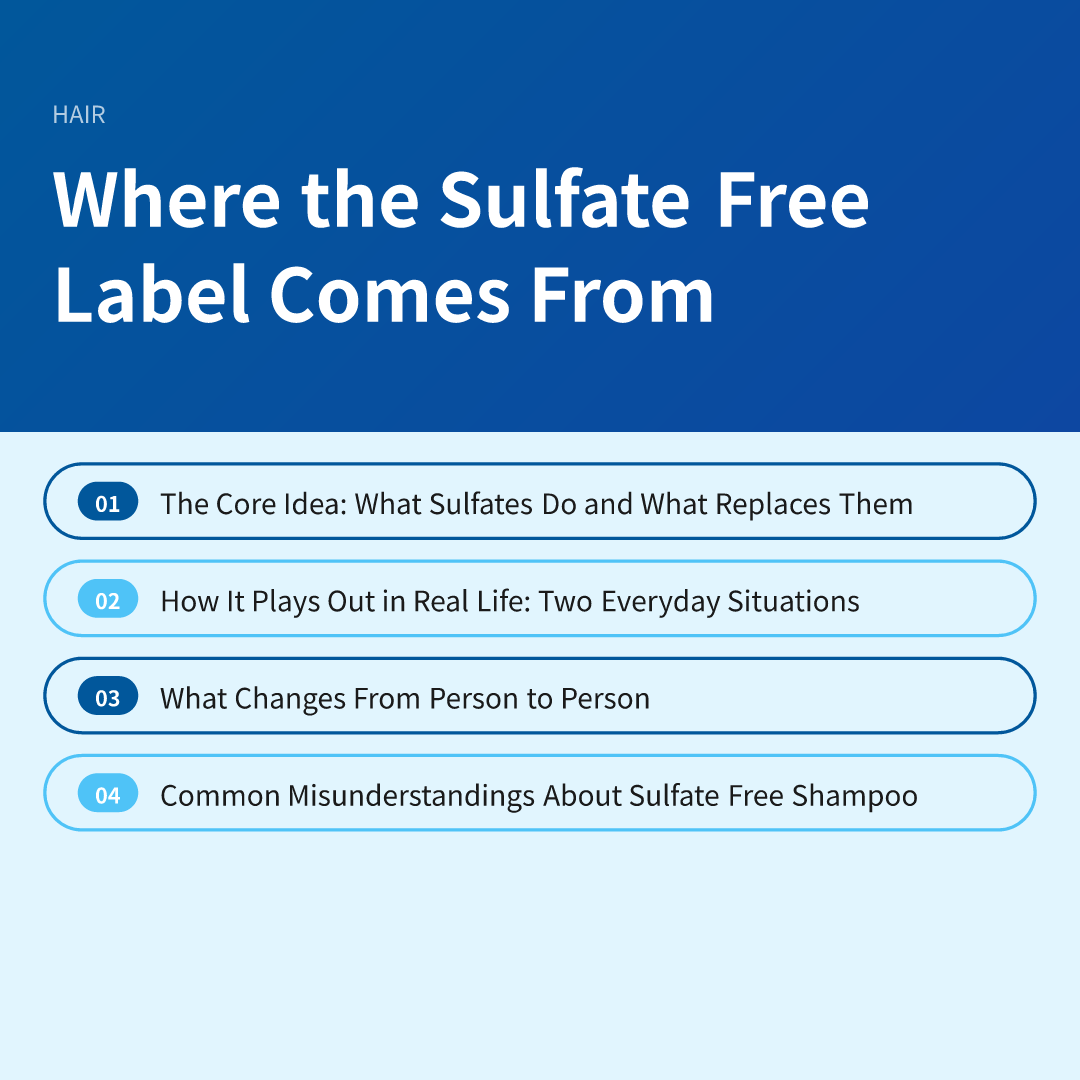
The Core Idea: What Sulfates Do and What Replaces Them
What sulfates actually do in a shampoo
Sodium lauryl sulfate and sodium laureth sulfate are the names most people see on labels. They are effective at removing oil and are responsible for the thick, bubbly lather many of us associate with "clean." That foam, however, is mostly a sensory cue. A shampoo can clean well with very little lather, and a big lather does not automatically mean a better wash.
Because sulfates are good at removing oil, some people find them a little too thorough. Hair that is dry, coarse, curly, or chemically treated tends to hold less natural oil to begin with, so a very strong cleanser can leave it feeling rough or tight. Others, especially those with oilier scalps, may feel perfectly fine using sulfate-containing products. There is no single right answer here.
What sulfate free formulas use instead
Sulfate free shampoos typically use other surfactants that are often described as milder. You may see names such as cocamidopropyl betaine, decyl glucoside, or sodium cocoyl isethionate on an ingredient list. These agents still clean; they just tend to do so with less foam and a different feel.
"Milder" is a relative word, though. It does not mean irritation-proof, and it does not mean every sulfate free formula is gentle. Ingredient lists are worth reading as a whole rather than judging a bottle by one missing word. For general information on how cosmetic ingredients are labeled in the United States, the FDA offers guidance on cosmetic labeling that explains how ingredients are listed.
how to read a shampoo ingredient listHow It Plays Out in Real Life: Two Everyday Situations
Concepts are easier to picture with examples. The two situations below are hypothetical, general scenarios meant to illustrate common patterns, not accounts of any specific person.
Situation one: curly, color-treated hair that feels dry
Imagine someone with naturally curly hair who also lightens it periodically. Their hair tends to feel dry between washes, and they have noticed that their usual lathery shampoo leaves it feeling a bit stripped. They are curious about switching to a sulfate free formula.
For a person like this, a milder cleanser is a reasonable thing to try, because dry or chemically treated hair is often described as more vulnerable to feeling rough after a strong wash. Some people in this situation report that their hair feels softer or more manageable with a gentler product. Others notice little change, and a few find that a very mild formula does not clean enough. It is also common for the transition to feel odd at first, since the lather is different and the scalp may need time to feel balanced. Results vary, and a gradual change often tells you more than a single wash.
Situation two: an oily scalp and heavy styling products
Now picture someone with a scalp that gets oily quickly, who also uses a lot of styling products such as gels, sprays, or dry shampoo. They have heard that sulfate free is "better" and have switched, but their hair now feels weighed down and coated by midweek.
Here the missing sulfate may not be the real issue. Heavier product buildup can be hard for a very gentle shampoo to lift, and some people in this position find that a stronger cleanser, used occasionally, suits them better. This does not make sulfate free shampoo a bad choice. It simply shows that "gentler" is not automatically "better" for every scalp and every routine.
What Changes From Person to Person
Several factors shape how a sulfate free shampoo feels in practice, and it helps to keep them in mind rather than expecting one universal result.
- Hair texture: Fine, straight hair, thick wavy hair, and tightly coiled hair all handle cleansing differently and hold moisture differently.
- Scalp oil production: Some scalps produce more oil than others, and that changes how much cleansing power feels comfortable.
- Styling habits: Frequent use of silicone-based products, heavy creams, or sprays can make buildup more noticeable with milder cleansers.
- Water type: Hard water leaves mineral residue that can make any shampoo, sulfate free or not, feel less effective.
- Skin sensitivity: People with easily irritated scalps may react to fragrance, preservatives, or other ingredients regardless of the surfactant type.
Because of all these variables, it is normal for two people to use the exact same bottle and have very different opinions about it. If something feels off, that is useful information about your hair and scalp, not a failure on your part.
The adjustment period
People who switch often mention an adjustment stretch where hair feels different, sometimes a little heavier or less "squeaky clean." Whether this reflects hair adapting, residue from previous products, or simply a different cleansing feel is not something anyone can say for certain for every person. Patience and a gradual approach tend to help you judge whether a formula suits you.
Common Misunderstandings About Sulfate Free Shampoo
"Sulfates are toxic and should always be avoided"
This claim circulates widely online, but it overstates the situation. Sulfates are common cleansing ingredients, and regulators oversee cosmetic ingredients in many regions. According to the FDA, cosmetic products and their ingredients are subject to safety requirements, and manufacturers are responsible for the safety of what they sell. That said, some people do find sulfates irritating, particularly those with sensitive skin or scalp conditions, so personal tolerance matters more than blanket rules.
"No lather means it is not cleaning"
Lather is largely a feel-good signal. Many mild cleansers produce less foam and still remove oil and residue. Judging a shampoo only by its bubbles can lead you to think a gentle product is failing when it is simply behaving the way it was designed to.
"Sulfate free means natural, safe, or hypoallergenic"
None of those follow from the label. A sulfate free shampoo can contain fragrance, essential oils, or preservatives that irritate some scalps. Terms such as "natural" or "gentle" on a package are marketing language, and they do not guarantee that a product will be comfortable for you. Reactions vary from person to person.
"Sulfate free shampoo will fix hair damage or hair loss"
A milder cleanser may help hair feel softer or less stripped during washing, but it is not a treatment for damage, thinning, or scalp conditions. If you are noticing increased shedding, a persistently itchy or flaky scalp, redness, or pain, those are worth discussing with a qualified professional rather than trying to solve with a label swap. The American Academy of Dermatology provides general public information on hair and scalp concerns that can help you understand when to seek an evaluation.
"You must use sulfate free forever once you switch"
There is no rule that says you have to commit to one type for life. Some people alternate, using a gentler formula for regular washes and a stronger one occasionally when buildup accumulates. Others stay with a single kind. Treat it as a flexible choice rather than an identity.
Practical Things to Keep in Mind When Choosing
If you are considering a switch, a few general points can make the decision less confusing. These are informational pointers, not personal advice.
- Read the full ingredient list rather than relying on the front-of-bottle claim.
- Consider your hair type, how oily your scalp tends to get, and how much styling product you use.
- If you have a known sensitivity or a diagnosed scalp condition, ask a qualified professional before changing products.
- If you use medicated or prescription shampoos, check with a pharmacist or doctor before swapping or combining products, since directions for those come from a prescriber or the product label.
- Give a new product a fair, gradual trial before deciding whether it suits you.
Price is not a reliable indicator either. Some affordable formulas work well for certain people, and some pricey ones do not. What matters is the fit between the formula and your own hair and scalp.
The Short Version
Sulfate free shampoo explained simply: it is a cleanser that leaves out a particular group of strong detergents and relies on milder ones, which may feel gentler for some hair types and less satisfying for others. It is a reasonable option to explore, not a cure-all and not something everyone needs.
- Sulfate free formulas use milder cleansing agents, so they often lather less, and that does not mean they clean less.
- Whether the switch helps depends on your hair texture, scalp oiliness, styling habits, and sensitivities, so results vary.
- The label does not guarantee a product is natural, hypoallergenic, or suited to hair damage or scalp problems.
Consider talking with a dermatologist or another qualified professional if you have persistent itching, redness, flaking, pain, noticeable shedding, or any reaction that does not settle after you stop a product. They can look at your actual scalp and hair, which no article can do. For anything involving a medicated shampoo, a pharmacist or doctor is the right person to ask about how it should be used.
Disclaimer: This article is for informational purposes only and is not a substitute for professional medical advice, diagnosis, or treatment. Please consult a licensed professional for personal health decisions.